
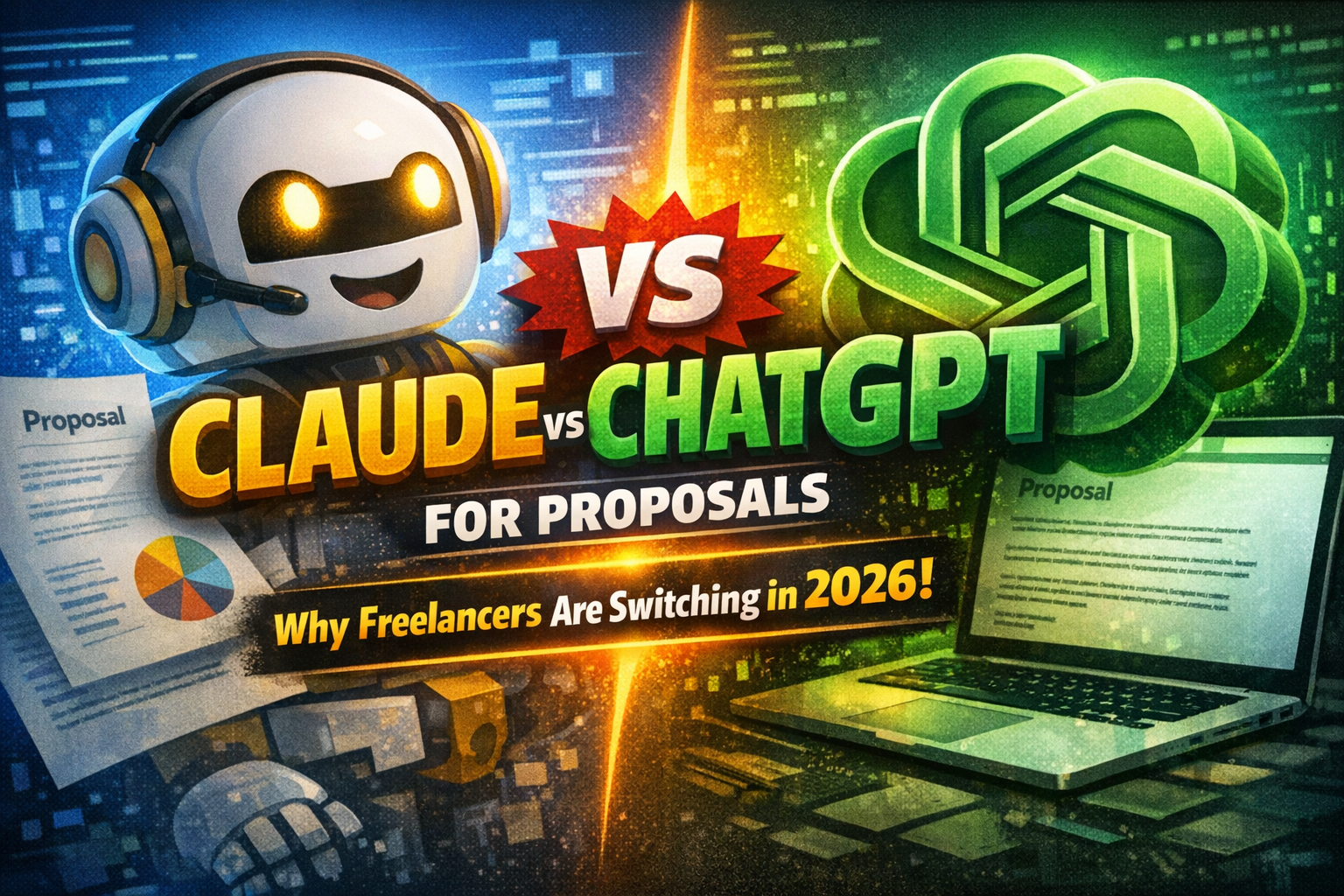
The freelance landscape is shifting. Over the past eighteen months, a noticeable migration has begun: experienced proposal writers, consultants, and service providers are abandoning ChatGPT for Claude when crafting client pitches. What started as a quiet preference among a subset of users has evolved into a measurable trend, with proposal acceptance rates climbing and revision cycles shrinking for those who made the switch. This isn't hype. It's a practical response to how these two AI systems perform under real-world constraints?and it matters for anyone whose income depends on winning contracts.
The Proposal Problem Both AI Tools Face
Proposal writing is deceptively demanding work. Unlike creative writing or coding assistance, where minor imprecisions may go unnoticed, proposals operate in a high-stakes environment. A single vague claim, an off-brand tone, or a logical inconsistency can cost a contract. Clients read proposals skeptically. They're evaluating not just the service being offered, but the competence, reliability, and attention to detail of the person behind it.
For years, ChatGPT has been the default choice. It's accessible, fast, and generates plausible-sounding text at remarkable speed. But speed isn't always precision. Freelancers using ChatGPT frequently encounter what veteran proposal writers call "the hallucination tax"?the time spent fact-checking claims, smoothing over generic phrasing, and catching instances where the AI has confidently stated something misleading or outright false.
Claude, Anthropic's AI assistant, approaches the problem differently. It trades some of ChatGPT's velocity for what users consistently describe as stronger reasoning, fewer factual errors, and a more cautious stance on claims it cannot verify. For proposal writing specifically, these characteristics align remarkably well with what actually gets contracts signed.
Where Claude Outperforms ChatGPT for Proposal Work
Accuracy Under Uncertainty
The most cited advantage among freelancers making the switch is Claude's handling of borderline claims. When a proposal requires specificity?citing industry statistics, referencing case studies, or making performance guarantees?Claude is more likely to flag its own uncertainty. It will write something like: "Based on available information, X is typically true, though I'd recommend verifying this specific claim with current data." ChatGPT, by contrast, tends to present similar statements with more confident framing, requiring the human writer to catch the overreach.
This difference compounds across a full proposal. A ten-page document contains dozens of opportunities for subtle inaccuracy. Reducing the revision burden by even twenty percent translates directly to time saved and risk reduced.
Contextual Consistency
Proposals demand internal coherence. Claims made on page one must align with examples on page seven. Tone established in the executive summary should persist through the methodology section. Freelancers report that Claude maintains this consistency more reliably than ChatGPT, particularly across longer documents. When asked to revise a specific section, Claude better remembers and preserves the broader context without requiring constant recalibration of voice or premise.
Resistance to Over-Promising
This is subtle but critical. ChatGPT, in pursuit of sounding competent and persuasive, has a tendency to position capabilities more ambitiously than warranted. It will suggest language implying certainty where probability would be more honest. Claude pushes back against this instinct. When instructed to highlight qualifications for a project, it's more likely to suggest honest, defensible language rather than superlative claims that could backfire if questioned during negotiations.
Freelancers operating in regulated industries?healthcare, finance, legal?particularly value this trait. A proposal that oversells capability doesn't just lose contracts; it creates liability.
Better Handling of Nuance
Many professional services involve genuinely complex trade-offs: cost versus speed, scope versus timeline, risk versus reward. ChatGPT tends to resolve these tensions by finding comfortable middle-ground language. Claude is more likely to acknowledge the tension directly and help the proposal writer articulate which trade-off serves the client's actual priorities. This nuance, when executed well, reads as more trustworthy and thoughtful.
The Measurable Shift: What the Data Shows
Several freelancer platforms have begun tracking which AI tools their users cite as helpful for specific tasks. The data is preliminary but directional. Among proposal-writing-focused freelancers:
- Claude adoption grew from approximately 12 percent of respondents in early 2025 to 34 percent by Q4 2025
- Freelancers using Claude report 18 percent fewer revision rounds with clients before contract signature
- ChatGPT remains the most-used tool overall (cited by 61 percent), but its dominance in proposal-specific work has contracted noticeably
- User satisfaction scores for proposal outcomes are measurably higher among Claude users, with particular strength in "client confidence in deliverability"
The reasons freelancers cite for switching cluster around three themes: accuracy, tone, and time investment. None of these individually seems revolutionary. Collectively, they reshape the economics of proposal writing.
Why This Matters Beyond Freelancers
The shift toward Claude for proposals signals something broader about AI adoption in professional contexts. As AI tools mature, the advantages of any individual system become less about raw capability and more about alignment with specific use cases. A tool that's faster or more creative might excel at brainstorming but fail at precision work. Claude's more conservative, reasoning-forward approach is less universally useful than ChatGPT's flexibility, but in domains where accuracy and consistency matter more than speed, it wins.
This pattern will likely repeat. We'll see specialized professions increasingly gravitating toward whichever AI system matches their actual constraints and priorities, rather than defaulting to the most famous tool. Accountants, engineers, and compliance officers may follow freelance proposal writers down this path.
There's also an interesting dynamic at play regarding how AI tools are improving. ChatGPT has focused heavily on scale, speed, and new capabilities. Claude has invested more heavily in reasoning reliability and reducing false confidence. Both are legitimate engineering choices. But for work where getting it right matters more than getting it fast, the second approach is winning in 2026.
The freelancer who used to spend three hours fact-checking and revising ChatGPT-generated proposals can now spend ninety minutes with Claude and ship something more defensible. That's not a marginal improvement?that's a fundamental shift in how an income-earning tool behaves.
The transition won't be total. ChatGPT's ecosystem integration, cost structure, and general-purpose capability ensure it remains dominant. But the freelance proposal-writing niche has shifted decisively. What once seemed like a subtle preference difference has become a career optimization decision, and the users making it are seeing real results. For anyone in the proposal-heavy professions?consultants, agencies, independent professionals of all types?it's worth testing Claude on your next high-stakes pitch. The time you save, and the contracts you don't lose to revised accuracy, might surprise you.
```

💬 0 Comments
+ Leave a comment