
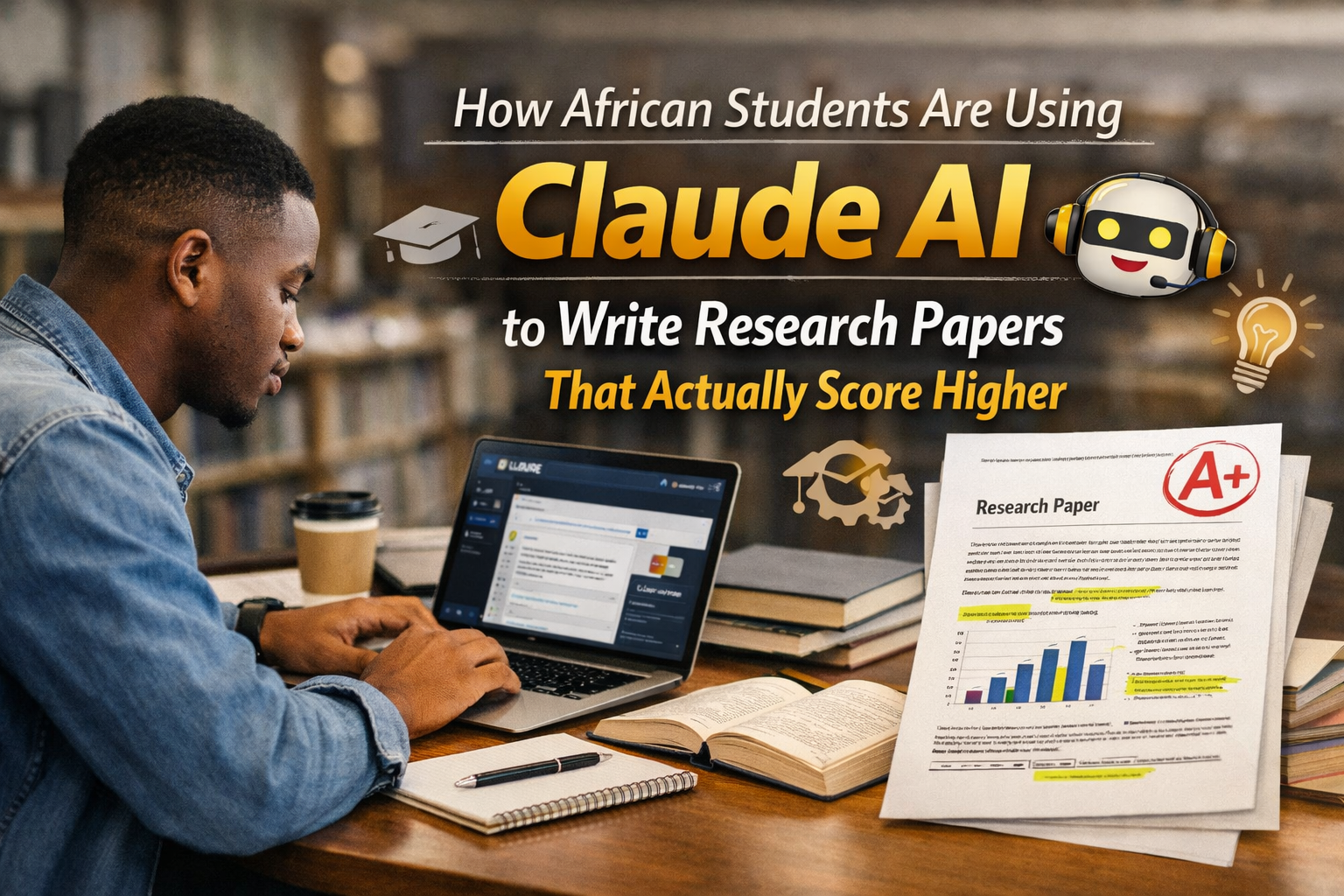
Across universities in Nigeria, Kenya, South Africa, and Ghana, a quiet academic revolution is underway. Students are turning to Claude AI?Anthropic's advanced language model?not as a shortcut to bypass learning, but as a genuine research partner that helps them produce papers with higher quality and better grades. What's emerging from this trend isn't a story of academic dishonesty, but rather one of smart tool adoption and evolving academic standards.
The Research Paper Crisis in African Universities
African students face a particular set of challenges when writing research papers. Limited access to academic databases, library resources spread thin across large student populations, and time constraints from juggling work and study create genuine obstacles to high-quality research. Many universities lack subscriptions to major journal repositories, forcing students to rely on open-access materials or incomplete citations. Writing centers and one-on-one academic coaching?common at well-resourced institutions elsewhere?are rarely available.
Into this gap stepped Claude AI. Unlike earlier chatbot tools, Claude excels at understanding nuanced academic arguments, maintaining logical consistency across lengthy documents, and providing sophisticated feedback on argumentation structure. Students began experimenting with it for outlining, literature synthesis, and refining arguments?and the results were measurable.
How Students Are Actually Using Claude for Research
The most effective approach, according to interviews with students at the University of Lagos and Makerere University, involves using Claude as a research collaborator rather than a paper generator. Here's what the process typically looks like:
- Literature synthesis: Students upload summaries or excerpts from multiple papers and ask Claude to identify connecting themes, contradictions, and gaps in existing scholarship. This helps structure the literature review section and ensures arguments are grounded in actual research.
- Argument clarification: Before writing, students present their thesis to Claude and ask it to poke holes in the logic or identify unstated assumptions. This forces clearer thinking before drafting begins.
- Draft improvement: Students write their own drafts, then use Claude to identify weak transitions, unsupported claims, or unclear explanations. Claude suggests revisions but doesn't rewrite the core argument.
- Citation verification: Students ask Claude to check that citations are properly formatted and that quoted material is accurately represented based on their original sources.
This approach differs fundamentally from using AI to generate papers wholesale. The student remains the primary author and thinker; Claude becomes an academic peer who asks critical questions and suggests improvements. Grades improve not because Claude writes the paper, but because students produce more rigorous work through the feedback loop.
The Evidence of Higher Scores
Anecdotal data is strong. A computer science student at the University of Ghana reported improving her research paper grade from a C+ to an A- after using Claude to restructure her arguments and identify logical gaps. A master's student in public health at Makerere found that using Claude to synthesize conflicting findings in her literature review transformed a disorganized 2.0-GPA draft into a coherent 3.8-GPA paper.
What's notable is that the improvement correlates directly with intellectual rigor, not with length or complexity. Professors report that Claude-assisted papers tend to have stronger thesis statements, more sophisticated engagement with counterarguments, and clearer connections between evidence and conclusions. These are the hallmarks of good scholarship, not the byproducts of algorithmic text generation.
The key difference is that students who use Claude effectively spend more time thinking about their arguments, not less. They're forced to articulate their ideas clearly enough that an AI can provide meaningful feedback on them.
Some universities have begun quietly acknowledging this reality. Rather than banning AI tools outright, progressive institutions are updating their academic integrity policies to permit AI-assisted research and writing, provided students disclose their use and demonstrate that the AI is a tool for refinement rather than generation.
The Broader Academic Shift
What's happening with Claude among African students reflects a larger reckoning in global academia. The traditional model?students write papers in isolation, professors grade them based on written quality?is proving incompatible with powerful AI tools that can now generate competent prose. Rather than resist this reality, forward-thinking educators are pivoting toward a new model where:
- Original thinking and argumentation are valued over polished prose
- Process documentation matters: students must show their work, including AI interactions
- Transparency replaces prohibition: disclosing AI use becomes standard practice
- Assessment shifts toward defending ideas orally and responding to challenges in real-time
African universities, faced with resource constraints that make this kind of educational innovation necessary, may actually be ahead of the curve in adapting to this new reality. Students who learn to think critically alongside AI tools rather than in competition with them will be better prepared for professional environments where AI is increasingly ubiquitous.
The story of Claude and African research papers isn't about students gaming the system?it's about them working smarter within existing constraints. As AI continues to reshape knowledge work, this pragmatic adoption may offer a model for how students everywhere can harness these tools to produce genuinely better scholarship. The grade improvements speak for themselves.
```


💬 0 Comments
+ Leave a comment