
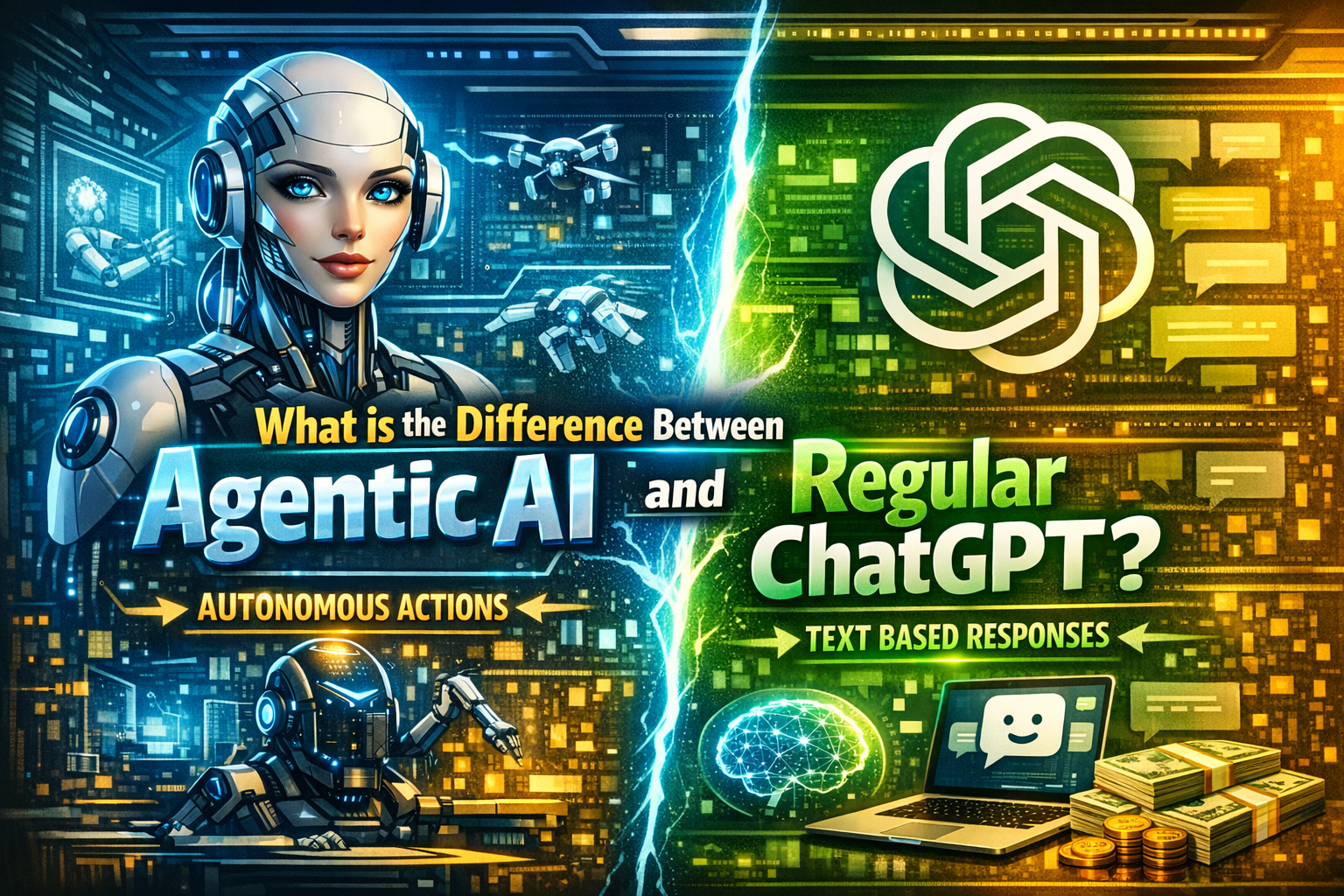
The artificial intelligence landscape has undergone a seismic shift in recent years, and the emergence of agentic AI represents one of the most significant developments since the public release of ChatGPT in November 2022. While most people are familiar with conversational AI models like ChatGPT?tools that respond to user prompts with human-like text?agentic AI operates on an entirely different paradigm. Understanding the distinction between these two approaches is crucial for anyone seeking to grasp where AI technology is headed and how it will reshape workflows across industries.
The Fundamental Architecture Difference
At its core, ChatGPT and similar large language models (LLMs) are fundamentally reactive systems. They receive input from a user and generate output based on patterns learned during training. The interaction is straightforward: prompt in, response out. The model doesn't initiate action, plan sequences of tasks, or persist goals across multiple interactions. Each conversation exists in relative isolation, and the model has no intrinsic motivation to accomplish anything beyond generating the next token in a response.
Agentic AI, by contrast, is proactive and goal-oriented. These systems are built on a foundation of autonomous decision-making. An agentic AI system receives a high-level objective, breaks it down into constituent tasks, executes those tasks independently, monitors progress, and adjusts its approach based on outcomes. Critically, agentic systems can take actions in the world?or at least in digital environments?without waiting for human confirmation at each step.
The architectural difference runs deep. While ChatGPT relies on transformer architecture primarily designed for language prediction, agentic systems layer additional components on top: planning modules, memory systems, tool-use frameworks, and feedback loops that enable iterative refinement. Think of it as the difference between a calculator that responds to queries and a robot that pursues objectives.
Autonomy and Decision-Making
Perhaps the most consequential difference lies in autonomy. ChatGPT requires human direction at every turn. You must ask it questions, evaluate its responses, decide what to do with the information, and provide new prompts. The human remains the active agent; ChatGPT is a sophisticated oracle responding to queries.
Agentic AI systems operate with significantly greater autonomy. Once given an objective?such as "analyze our Q3 sales data, identify trends, create visualizations, and prepare a presentation"?an agentic system can accomplish this without human intervention. It will:
- Access necessary data sources independently
- Perform analysis and draw conclusions
- Use available tools (spreadsheet software, design tools, etc.)
- Monitor quality and correctness of intermediate outputs
- Handle errors and adapt its approach
- Deliver a completed artifact without human oversight
This autonomy introduces both tremendous opportunity and novel risks. While agentic systems can dramatically accelerate work, they also require careful oversight to ensure they remain aligned with human intentions and don't pursue goals in harmful or unintended ways.
Tool Use and Environmental Interaction
ChatGPT can discuss tools and provide instructions for using them, but it doesn't directly interact with software, databases, or APIs in a truly autonomous manner. When integrated with plugins or external services, ChatGPT still operates primarily as a language interface?translating user intent into appropriate function calls, then interpreting results back into language.
Agentic systems, by design, are tool-native. They actively use external tools as part of their normal operation to accomplish objectives. An agentic system might automatically write and execute code, query databases, call APIs, manage files, or control software applications. The tools aren't optional add-ons; they're integral to how the system functions.
The key distinction is that agentic AI systems treat tool usage as a primary mechanism for task completion, while ChatGPT treats tools as secondary capabilities?nice to have, but not fundamental to how the system operates.
This difference has profound implications. An agentic AI might debug a software issue by examining code, running tests, identifying the problem, proposing fixes, and implementing solutions?all without asking a human for permission between steps. ChatGPT could describe how to debug the same issue, but it wouldn't independently execute the solution.
Memory, Context, and Persistence
While recent versions of ChatGPT can maintain conversation history within a single session, the system has limited persistent memory across conversations. Once a chat ends, that context is largely lost. The model doesn't "remember" previous interactions or build on past learnings about a specific user or problem domain.
Agentic AI systems, by necessity, maintain richer forms of memory and context. They need to:
- Remember objectives and progress toward goals
- Retain learnings from previous attempts and failures
- Maintain awareness of dependencies between tasks
- Track states in ongoing processes
- Access long-term information about the environment they operate in
This persistence enables agentic systems to engage in multi-step projects that unfold over extended periods. An agentic system might manage a month-long marketing campaign, continuously monitoring performance, adjusting tactics, and learning from results?all while maintaining coherent context throughout.
Practical Implications and Use Cases
These architectural differences manifest in dramatically different practical applications. ChatGPT excels when the value lies in explanation, creative writing, coding assistance, brainstorming, or answering specific questions. It's phenomenal for interactive work where humans drive direction and interpretation.
Agentic AI shines when the value lies in autonomous task completion, process automation, complex project management, or situations requiring coordinated action across multiple systems. Imagine an agentic AI handling:
- End-to-end customer service interactions?investigating issues, accessing systems, implementing solutions
- Research projects?finding sources, synthesizing information, generating reports without human coordination
- Software development?writing code, testing, debugging, and deploying features with minimal oversight
- Business operations?managing workflows, coordinating between systems, and handling exceptions
- Scientific research?designing experiments, collecting data, analyzing results, and proposing next steps
Real-world deployments are beginning to emerge. Anthropic's recent work with agentic systems, alongside developments from DeepSeek, OpenAI's o1 model, and others, demonstrate increasing capability. Companies are experimenting with AI agents that handle customer support tickets end-to-end, manage software deployments, and perform research tasks with minimal human intervention.
The Current State and Future Trajectory
It's important to note that truly sophisticated agentic AI remains in relatively early stages. Most current systems exhibit agent-like qualities rather than representing fully autonomous agents. They work well on structured tasks but struggle with novel situations requiring human judgment or ethical reasoning. The technology is rapidly advancing, but we're not yet at the point of fully autonomous, generally-capable agents operating freely in complex environments.
ChatGPT, meanwhile, continues to improve and will remain tremendously valuable. The distinction between these approaches isn't hierarchical?agentic AI isn't simply "better" ChatGPT. They're fundamentally different tools designed for different purposes. ChatGPT's interactive, responsive nature makes it superior for many use cases. Its ability to engage in nuanced dialogue, offer creative suggestions, and adapt to unclear requirements remains unmatched by current agentic systems.
The future likely involves both systems operating in tandem. Agentic systems might handle routine, well-defined work while ChatGPT-like models assist humans with creative and analytical tasks. Organizations will increasingly need to understand when to deploy each approach, how to oversee autonomous systems responsibly, and how to design workflows that blend human intelligence with AI capabilities.
The emergence of agentic AI represents a genuine inflection point in how we'll interact with artificial intelligence. While ChatGPT democratized access to AI capabilities and changed how people work, agentic systems promise to redefine what's possible when AI systems can pursue objectives independently. Understanding this distinction isn't


💬 0 Comments
+ Leave a comment