
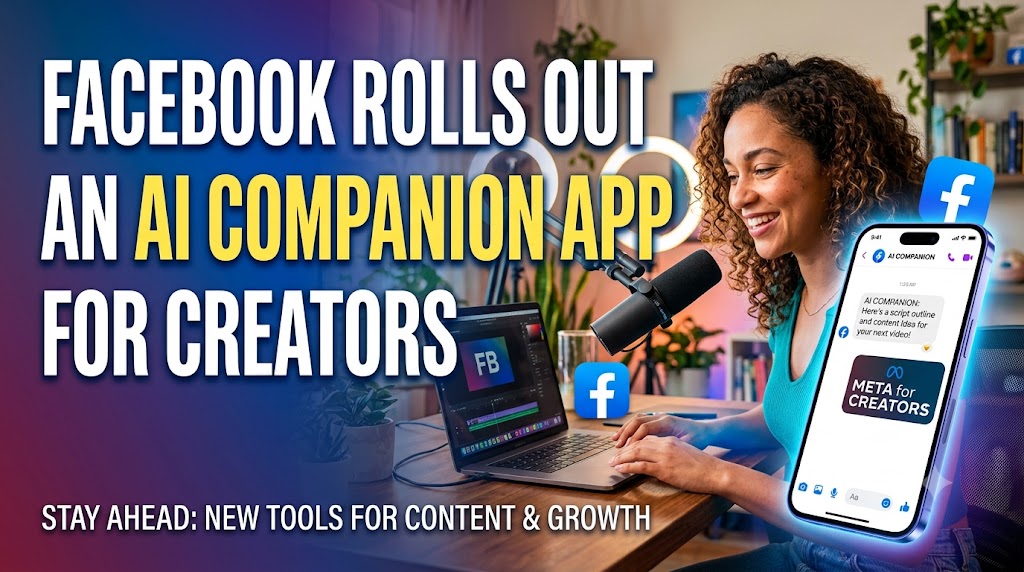
Facebook just launched an AI companion app designed specifically for creators—and it's a direct shot across the bow of every other creator tool platform operating today. The social media giant is moving fast, very fast, to embed generative AI into the hands of content makers who are already hooked into its ecosystem. This isn't a beta. This isn't a whisper campaign. This is a full-court press to make sure creators choose Meta's AI over everything else.
The app, still rolling out in limited regions, gives creators access to Meta's proprietary AI models to generate content ideas, optimize captions, schedule posts, and even produce draft video concepts. For creators juggling multiple platforms, multiple audiences, and multiple revenue streams, this could be a game-changer. But there's a catch—and there's always a catch.
What Facebook's Creator AI Actually Does
Meta's new AI companion isn't just another chatbot sitting in your notifications. It's positioned as a production assistant that understands the creator economy from the inside. Here's what's actually shipping:
- Content brainstorming: The AI analyzes your past performance, audience demographics, and trending topics to suggest what to create next.
- Caption and hashtag optimization: Auto-generated captions tailored to maximize engagement on Facebook, Instagram, and Threads.
- Posting strategy: The AI recommends when to post based on when your audience is most active.
- Video concept generation: Early versions can suggest video formats and structures—though the actual editing still falls to the creator.
- Analytics interpretation: The AI reads your creator dashboard and explains what's working and why.
This is the kind of functionality that content creators have been asking for since the algorithm became impossible to game manually. And unlike scattered third-party tools, this lives inside the platform where creators already spend their time. No extra logins. No subscription switching. No context loss.
The timing matters enormously. Creators are already stretched thin trying to understand how to use the 8 AI tools every content creator needs in 2026, and many are still learning which workflows actually move the needle. Meta is betting that integrating AI directly into the creation process removes friction and increases adoption faster than waiting for creators to piece together their own tool stacks.
Why This Matters Right Now
Facebook isn't alone in this space anymore. YouTube, TikTok, Instagram, and X are all racing to embed AI deeper into their platforms. But Meta has something the others don't quite: ownership of multiple massive platforms (Facebook, Instagram, Threads) where a single AI assistant can work across all of them.
The competitive pressure is real. Meta's Llama 4 represents the most important open-source AI release in history, and the company is clearly serious about not being dependent on third-party AI providers. This creator app is built on Meta's own models. That's strategic.
"The creator economy is moving faster than most people realize. Creators who don't adopt AI tools in 2026 will find themselves competing against creators who do—and the gap will compound quickly."
For creators in Africa and emerging markets, this is particularly significant. Many operate on razor-thin margins and can't afford premium tools. If Meta offers a solid AI assistant at no additional cost, it could dramatically level the playing field between creators in wealthy markets and those operating from Lagos, Nairobi, or Kampala.
That said, this also raises questions about the honest truth about AI and jobs that nobody wants to say out loud. If AI can generate content ideas, captions, and strategy recommendations, does that increase demand for human creators or cannibalize it? The answer is probably both.
The Competitive Landscape Just Got Complicated
Meta's move puts enormous pressure on the 10 AI automation tools that will replace your entire workflow in 2026. Standalone tools like Buffer, Later, and Hootsuite suddenly look less essential if creators can get 80% of the functionality for free inside Facebook and Instagram. That's not good news for the third-party creator tool ecosystem.
However, it's worth noting that platforms have a history of promising comprehensive tools and delivering mediocre execution. We've seen this movie before. Meta could stumble. The AI might generate bland suggestions. It might not understand niche communities. It might be slow to adapt as trends shift.
Creators who've experimented with AI tools know the landscape: Claude vs ChatGPT vs Gemini—when I used all three for 30 days, Claude was clearly better for nuance work. Different AI models have different strengths. Meta's assistant might be excellent at broad strategy but weak at creative ideation. Or vice versa. The reality is that no single AI does everything equally well.
Smart creators will likely treat Meta's AI companion as one tool in a larger arsenal. AI video generation tools in 2026 that actually work are still specialized and niche. If you need serious video production capability, you'll probably still need dedicated tools. Meta's assistant is more likely to complement than replace.
What Creators Should Do Right Now
If you're eligible for early access, test it. Seriously. The worst that happens is you spend a few hours figuring out it's not useful. The best case is you find a tool that saves you 5-10 hours per week. For creators trying to build an AI startup in 2026 without writing a single line of code, internal platform tools are force multipliers.
But understand what you're trading: data. Every suggestion the AI makes is based on analyzing your content, your audience, your engagement patterns. Meta already has this data, but now it's being processed through an AI lens. If you're uncomfortable with that level of algorithmic scrutiny, you should know that upfront.
Also, understand that platform tools change. What works today might be deprecated tomorrow. Using AI to dominate SEO in 2026 requires understanding how algorithms work, and platform algorithms change constantly. Building your entire strategy around a single tool—even one built into the platform itself—is risky.
For African creators specifically, this is worth testing early because Meta has been more attentive to emerging market creators than most platforms. The company understands that growth is elsewhere, not in saturated Western markets. If this AI assistant works well, it could give African creators genuine competitive advantage.
The Bigger Picture
This launch is another signal that African businesses that ignore AI in 2026 will not survive 2028. That might sound hyperbolic, but consider: if your competitor is using AI to generate content ideas 10x faster than you, they'll have more content to test, faster feedback loops, and quicker iteration cycles. Over time, that compounds.
The creator economy was already driven by speed and adaptability. Introduce AI to that equation, and creators who master these tools will pull further ahead of those who don't. This isn't about replacing human creativity. It's about augmenting it. The best creators will be those who use AI as a thinking partner, not a replacement.
Meta's timing here is shrewd. We're in a moment where AI is transitioning from "emerging technology" to "table stakes." Creators who ignore it now will find themselves at a disadvantage next year. OpenAI just dropped GPT-5 and it changes everything we thought we knew about AI, and every major platform is scrambling to keep pace. Meta is at least attempting to stay relevant by building AI directly into the creator experience.
The bottom line: Facebook's AI companion app for creators is exactly what the creator economy needed—a free, integrated tool that lowers the barrier to entry for AI-assisted content creation. Whether it's actually good enough to replace standalone tools remains to be seen. But for creators looking to dip their toes into AI without additional investment, this is your entry point. Test it, learn from it, and decide if it fits your workflow. Just remember that making $5,000/month using AI tools requires understanding which tools actually move the needle, and a free platform feature is only valuable if it genuinely saves you time or produces better results. Don't adopt it because it's free. Adopt it because it works.
```


💬 0 Comments
+ Leave a comment