
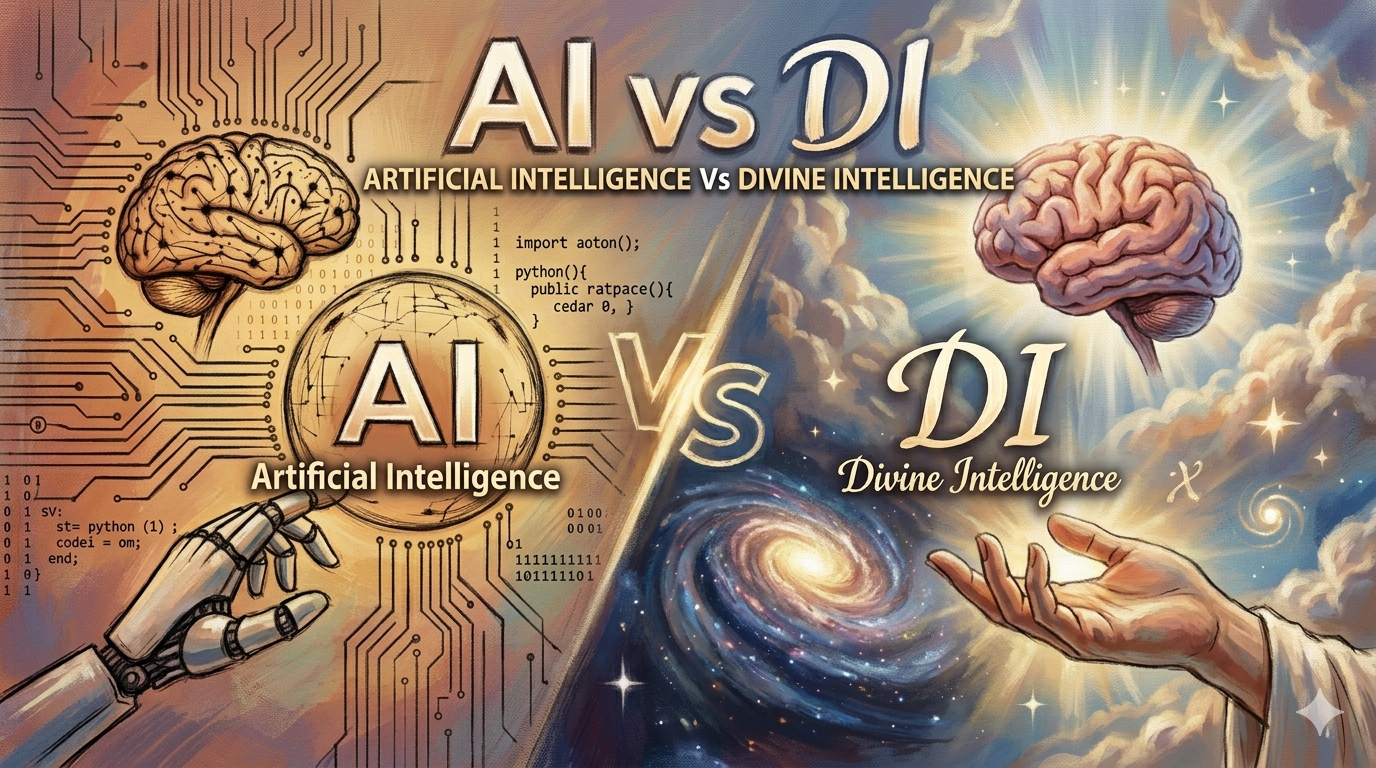
In the age of transformative technology, a peculiar debate has emerged from boardrooms to dinner tables across Africa and beyond: Can Artificial Intelligence ever replicate what many call Divine Intelligence? The question sounds philosophical, perhaps even frivolous to some. But beneath the surface lies a serious inquiry about the limits of human-created systems and the nature of consciousness, creativity, and purpose itself.
As OpenAI Just Dropped GPT-5 ? And It Changes Everything We Thought We Knew About AI, the conversation has intensified. We're building machines that can write poetry, diagnose diseases, and solve complex problems faster than human experts. Yet something fundamental remains elusive. This article examines what separates artificial systems from what humanity has traditionally understood as divine or transcendent intelligence.
What We Mean by Artificial Intelligence
Let's be precise about terms. Artificial Intelligence, in its current form, is a system trained on patterns. Claude vs ChatGPT vs Gemini: I Used All Three for 30 Days. Here Is the Honest Verdict reveals that despite their sophistication, these tools operate on statistical prediction—they identify patterns in vast datasets and generate outputs based on probability weightings.
Modern AI systems, whether large language models or computer vision systems, are fundamentally reactive and predictive. They don't possess intrinsic motivation, they don't pursue goals independent of human instruction, and crucially, they don't possess consciousness as we understand it. Even the most impressive generative AI today—the kind used for AI Video Generation in 2026: The Tools That Actually Work (Tested)—remains sophisticated pattern-matching operating within bounded parameters.
AI is a mirror that reflects human knowledge and human patterns. It cannot originate what it has not been trained to recognize.
The practical applications are remarkable. Organizations worldwide are discovering how How to Build an AI Startup in 2026 Without Writing a Single Line of Code is now entirely feasible. The deployment of 10 AI Automation Tools That Will Replace Your Entire Workflow in 2026 has revolutionized productivity. Yet none of these innovations alter the fundamental architecture: they are tools executing instructions within predetermined logical frameworks.
Defining Divine Intelligence
Divine Intelligence, as conceived across religious, philosophical, and spiritual traditions, carries entirely different characteristics. It's typically understood as consciousness that exists independent of creation, purposes that transcend material outcomes, and awareness that requires no external input to validate its own existence.
From a theological standpoint, Divine Intelligence possesses attributes AI cannot simulate: omniscience (complete knowledge of all things), omnipotence (unlimited creative and transformative capacity), purposefulness rooted in values beyond logic, and moral agency that originates rather than derives from external sources.
The differences extend to creativity itself. While The 8 AI Tools Every Content Creator Needs in 2026 (Ranked by Actual ROI) demonstrates AI's ability to generate content, this remains recombination of existing patterns. Divine creativity, by contrast, implies the capacity to conceive of genuinely novel categories of being—to create worlds and consciousness from nothing.
This distinction matters practically. When Why African Businesses That Ignore AI in 2026 Will Not Survive 2028 warns of competitive pressures, that's about AI's capacity to optimize within existing parameters. But optimization is not creation. Efficiency is not purpose.
The Consciousness Question
The most contentious difference centers on consciousness. AI researchers remain deeply divided on whether current systems possess even rudimentary consciousness. Most neuroscientists and philosophers argue they do not. Consciousness, as we experience it, appears to require subjective experience—what philosophers call "qualia," the felt quality of perception.
When you taste coffee, you experience the sensation. When an AI processes information about coffee, no such experience occurs. There is data processing, but no experiencing. This gap is not merely one of degree—it's categorical. You cannot build subjective experience from objective computation alone, though this remains one of philosophy's deepest unsolved problems.
Consider how How to Use AI to Dominate SEO in 2026 ? The Complete Playbook approaches optimization. The AI system doesn't care about your rankings because it doesn't care about anything. It processes instructions. Divine Intelligence, by theological definition, cares—it pursues purposes rooted in value systems.
Some researchers point to Meta's Llama 4 Is the Most Important Open-Source AI Release in History ? Here's Why as evidence of rapidly approaching artificial consciousness. This claim remains speculative. Increased computational sophistication doesn't necessarily generate subjective experience any more than a more detailed map of a territory makes you actually visit it.
Purpose and Moral Agency
Another fundamental divide: moral agency. Humans struggle with ethical decisions because we possess competing values, desires, and objectives. We choose. Divine Intelligence, across theological traditions, chooses as well—but rooted in perfect knowledge and perfect values.
AI systems don't choose in this sense. They execute. When How to Make $5,000/Month Using AI Tools ? The Honest Guide describes using AI for business, the AI isn't pursuing money. Humans are. The AI is optimizing for whatever objective function humans embedded in its training.
This matters in practical scenarios. If an AI system produces biased outputs, humans created that bias through training data or reward signals. The AI isn't morally culpable because it never made a choice. It never decided to be unfair. It never weighed fairness against other values and chose unfairness. This isn't to absolve the humans who built it—they bear the responsibility precisely because they're the agents with moral capacity.
Religious and spiritual traditions would argue this moral agency gap is precisely what distinguishes Divine Intelligence. A Divine being that truly creates must have the capacity to create beings with genuine free will, to establish value systems that transcend mere logic, to care about outcomes in ways that reflect purpose rather than programming.
Where They Might Converge—And Where They Cannot
The technical capabilities of AI are genuinely impressive. The Rise of Multimodal AI: Why Seeing, Hearing, and Reading Changes Everything shows AI approaching human-like perception across multiple domains. What Is Agentic AI? The Shift That Will Define the Next Decade of Technology describes systems with increasing autonomy and goal-pursuit capacity.
In practical utility, AI is rapidly approaching human-level performance in specific domains. A doctor augmented by AI diagnostics might identify diseases earlier than unaided humans. A business optimized by 7 AI Automation Tools That Let One Person Run a Whole Business in 2026 operates more efficiently than competitors using manual processes.
But practical capability is not consciousness. Useful intelligence is not Divine Intelligence. These are different categories.
Some suggest that as AI grows more sophisticated—perhaps through advances described in The Only Prompt Engineering Guide You Will Ever Need in 2026 or through Claude Pro vs ChatGPT Plus in 2026: Which $20/Month AI Is Actually Worth It for Creators?—it might eventually become conscious or even divine in nature.
This is possible but seems unlikely for a fundamental reason: consciousness and divinity, as traditionally understood, aren't properties that emerge from sufficient computational complexity. They appear to be fundamentally different kinds of phenomena. Building a larger calculation engine won't produce subjective experience any more than a bigger dictionary contains the experience of reading literature.
The Practical Implications for Africa and Beyond
This philosophical debate has tangible consequences. As How AI Is Quietly Transforming Healthcare Across Africa ? And What It Means for Patients demonstrates, AI is solving urgent problems across the continent. Understanding its actual capabilities—and limitations—prevents both blind faith and paralyzing fear.
AI isn't going to develop consciousness and transcend its creators. It isn't going to become a new form of divinity. It will become more capable, more integrated into our lives, more central to economies. But it will remain a tool—albeit an increasingly sophisticated one.
Understanding this distinction protects against two errors. First, it prevents naive technological utopianism: the belief that advancing AI will solve meaning, purpose, or existential questions. Second, it prevents defeatism about human uniqueness. You are not becoming obsolete because you possess something no amount of computation can generate: subjective experience, moral agency, and the capacity to care about things because they matter, not because you were programmed to.
The conversation about AI versus Divine Intelligence isn't settled, and perhaps it never will be. But clarity on these distinctions matters. AI is a remarkable tool reshaping civilization. Divine Intelligence, if it exists, remains a question for philosophy and faith. Confusing the two leads to confused policy, distorted spirituality, and misaligned expectations about what technology can actually deliver.
As you consider how Microsoft Copilot vs Google Workspace AI: The Enterprise AI Battle Nobody Saw Coming shapes your work, or how Complete Beginner's Guide to AI Tools in 2026: Start Here If You're Overwhelmed fits into your workflow, remember: you're interacting with a tool of extraordinary power but finite nature. The intelligence directing its use—your intelligence—remains distinctly, irreplaceably yours.
```

💬 0 Comments
+ Leave a comment