
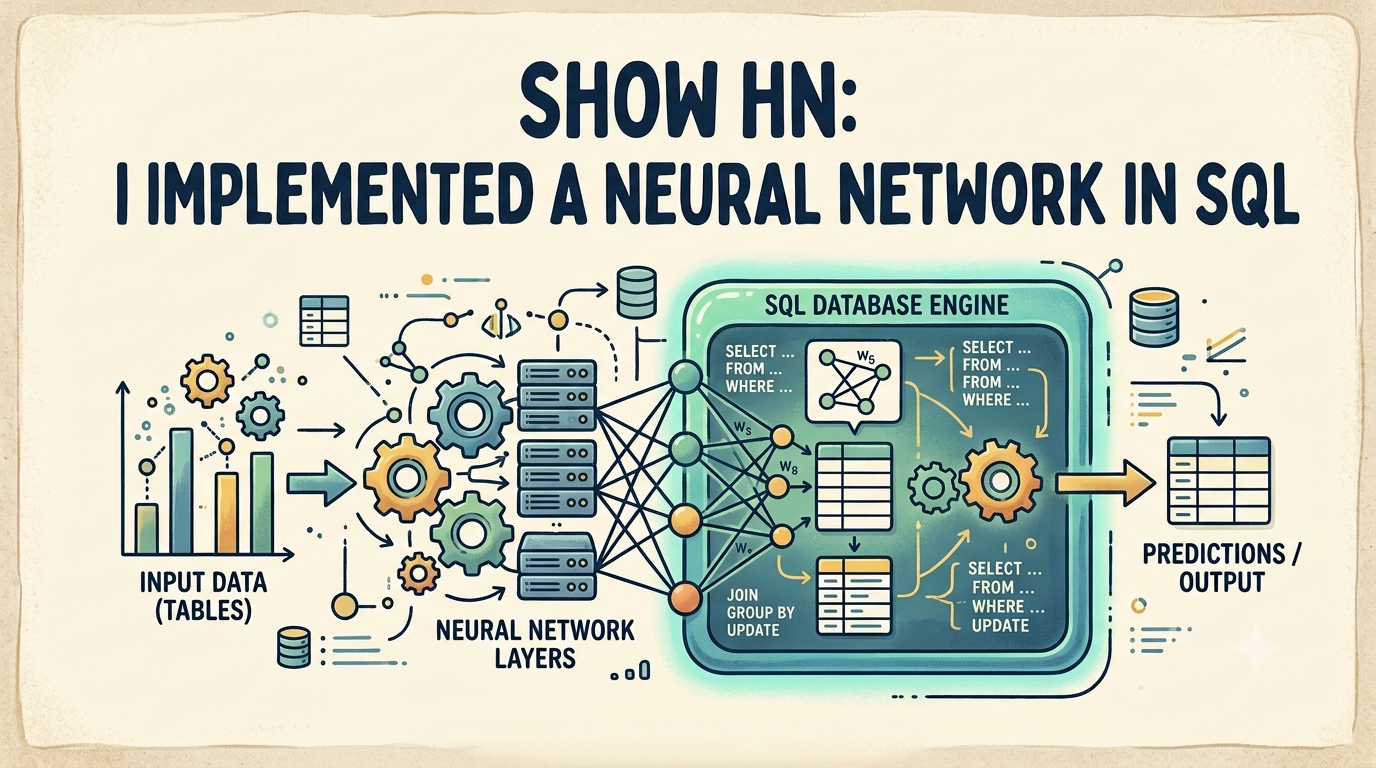
A developer has just demonstrated something that shouldn't theoretically work: training a neural network entirely through SQL queries. This isn't a trick or academic exercise—it's a functional implementation that processes image data, performs matrix operations, and adjusts weights through backpropagation, all within database constraints. The implications stretch far beyond database optimization into how we think about computational boundaries and tool versatility.
The Unconventional Architecture
The implementation uses xarray-sql, a framework that bridges the gap between array computing and relational databases. At its core, the neural network processes Fashion-MNIST dataset images—28x28 pixel handwritten clothing items—through a simple architecture: 784 input pixels feeding into a 196-neuron hidden layer, then 32 neurons with hyperbolic tangent activation, finally resolving to 10 output classes via softmax.
What makes this noteworthy is how the computation actually happens. Rather than numpy arrays passing through memory-optimized tensor operations, SQL performs the equivalent mathematical work through table joins, aggregations, and conditional logic. A layer's forward pass becomes a join operation between weight tables and activation tables. Backpropagation becomes a series of grouped aggregations and updates.
The developer trained this network on 490 samples (70% of 700 total) with 60 training steps at a learning rate of 0.5, processing data in chunks of 250 samples. This constraint-based approach reveals something important: computational fundamentals remain portable across execution contexts, though performance characteristics shift dramatically.
Performance Through Optimization
The implementation includes a critical optimization: skipping zero-valued pixels during the initial layer's computation. Since background pixels contribute nothing to the calculation (0 × weight = 0), removing them before the join operation shrinks the dataset meaningfully. On the Fashion-MNIST real dataset with approximately 50% zero pixels, this optimization delivered a 1.8x speedup, reducing per-step computation from 2.56 seconds to 1.45 seconds.
This optimization reveals how SQL-based machine learning can leverage database query planning in ways that traditional frameworks sometimes miss. Cardinality reduction before expensive operations—a fundamental database principle—directly translates to neural network training efficiency.
The framework supports both remote datasets and offline fallbacks. The demonstration loads Fashion-MNIST from cloud storage (S3-backed zarr format) when available, but includes a synthetic dataset generator for offline environments. This flexibility matters for practitioners exploring these boundaries without specialized infrastructure. For those considering broader infrastructure decisions, understanding available AI automation tools in 2026 becomes essential context.
Why This Matters Beyond Novelty
Implementing neural networks in SQL challenges our assumptions about technology separation. Database professionals understand SQL intimately. Machine learning practitioners speak TensorFlow or PyTorch. These communities rarely overlap, which creates blind spots.
This demonstration suggests that SQL's expressive power—particularly in systems with advanced query optimization—might handle more computational tasks than we typically delegate to specialized frameworks. For organizations deeply invested in SQL infrastructure, this opens possibilities for embedding learning directly into database pipelines without external systems.
The practical implications extend to building AI systems without extensive engineering overhead. If neural networks function within SQL, database administrators might implement certain ML workflows without recruiting machine learning engineers. This democratization angle shouldn't be overlooked—it reduces the specialization barrier for AI adoption.
However, this doesn't suggest SQL should replace optimized frameworks. A 1.45-second training step on 250 samples is extraordinarily slow compared to GPU-accelerated training. The value lies elsewhere: in educational contexts, in systems where SQL is the only available computational interface, or in proofs-of-concept that SQL can express these algorithms at all.
The Broader Context
Understanding computational flexibility matters as AI capabilities expand. When language models approach new capabilities, they remain fundamentally mathematical operations—operations that could theoretically execute across different substrates. The question shifts from "can this run here?" to "what execution trade-offs matter for this use case?"
For those working in AI professionally, the distinction between different AI platforms and their architectural choices becomes increasingly important. Each system makes fundamental decisions about where computation happens and why. The SQL neural network implementation demonstrates that these are sometimes social and organizational choices rather than pure technical necessities.
Organizations evaluating AI tools for specific workflows might benefit from questioning whether specialized systems are required or whether existing infrastructure could handle the tasks. This doesn't mean abandoning specialized tools, but rather understanding your actual constraints versus perceived ones.
Additionally, as enterprises grapple with implementing AI across different sectors and regions, recognizing that multiple execution paths exist for similar computations reduces dependency on particular vendors or technology stacks. Resilience comes from optionality.
Looking Forward
The significance of this work extends to how we train practitioners. Students learning machine learning typically begin with frameworks that abstract mathematical operations into convenient functions. Understanding that these operations decompose into fundamental database queries—joins, aggregations, conditional logic—builds intuition about what machine learning actually computes.
Similarly, database professionals encountering machine learning for the first time might feel overwhelmed by specialized terminology and frameworks. Recognizing that neural networks map onto relational operations they already understand reduces the mystification that often surrounds AI implementation.
The convergence of SQL and neural networks also hints at future system design. As agentic AI systems develop more sophisticated reasoning, embedding these capabilities into database layers could enable new architectural patterns. Imagine query optimization powered by learned models, or anomaly detection automatically improving through neural networks operating on database statistics.
Conclusion
This SQL neural network implementation succeeds not because SQL is an ideal environment for training deep models—it clearly isn't—but because it demonstrates computational universality. Mathematical operations underlying machine learning remain platform-agnostic. The frameworks we choose reflect performance requirements, team expertise, and ecosystem maturity rather than fundamental technical limits.
For anyone building AI systems or evaluating their infrastructure choices, this serves as a reminder to question conventional wisdom. If you're exploring what's possible with your current technology stack, understanding available AI tools and their actual capabilities becomes essential. And for those making hiring or organizational decisions around AI, understanding how AI adoption reshapes technical roles helps anticipate necessary changes in your team composition and skillsets.
```


💬 0 Comments
+ Leave a comment