
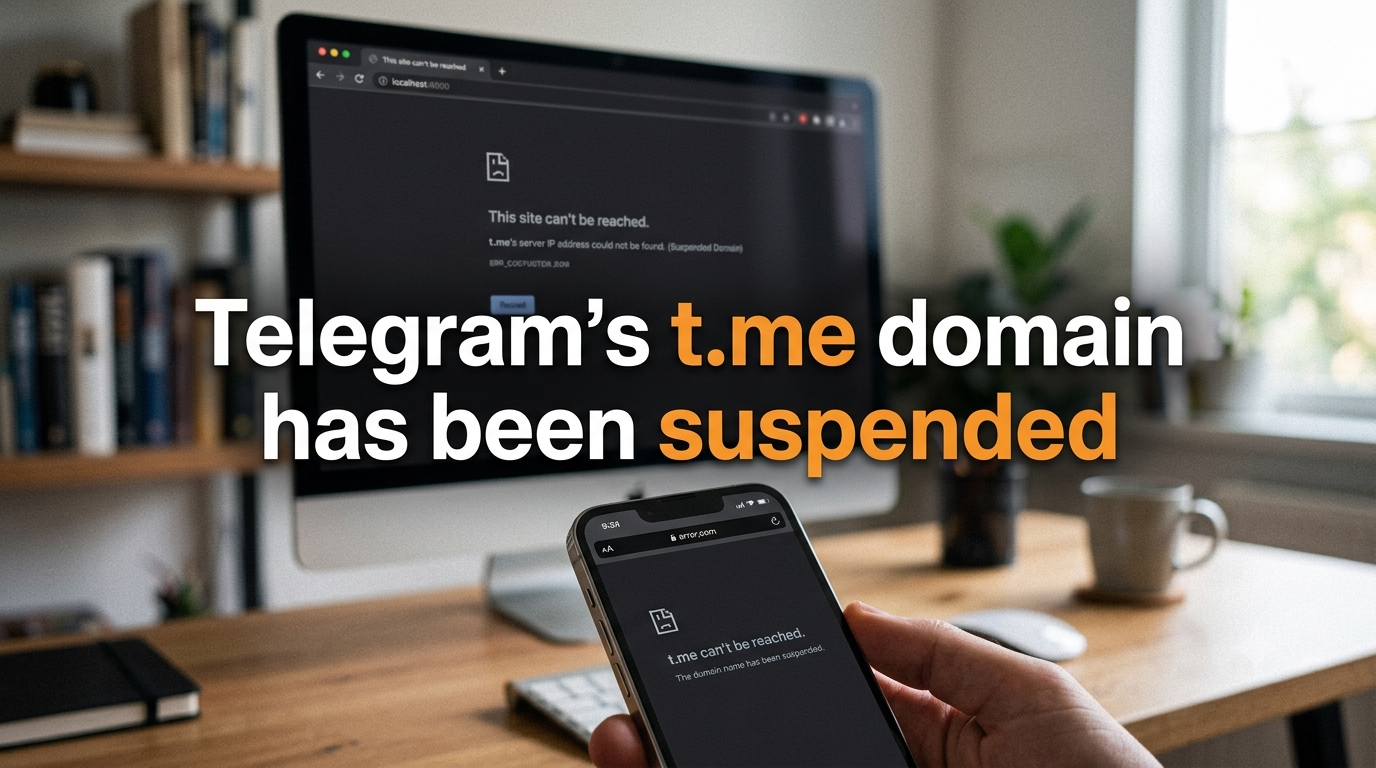
Telegram's abbreviated domain t.me has entered a precarious state, with multiple administrative restrictions now preventing standard operations—a development that raises questions about the messaging platform's infrastructure resilience and what this means for the billions of users who depend on it daily. When a domain of this significance encounters such severe constraints, it reverberates across the entire ecosystem that relies on it.
The Current Status of t.me: What's Actually Happening
The t.me domain, registered back in 2010 and currently managed through GoDaddy's infrastructure, is now operating under what can only be described as a locked-down state. According to the latest WHOIS data, the domain carries multiple prohibitive status codes that prevent standard operations: clientDeleteProhibited, serverDeleteProhibited, serverHold, clientRenewProhibited, clientTransferProhibited, serverTransferProhibited, clientUpdateProhibited, and serverUpdateProhibited.
In simpler terms, this means the domain cannot be transferred to another registrar, its renewal settings cannot be modified by the account holder, and both the hosting provider and the account owner have agreed (or been forced) to prevent deletions. The serverHold status is particularly concerning—it suggests the registry operator itself has placed a hold on the domain, which is typically done when there's a dispute, legal issue, or other serious concern.
For context, this is the domain that serves as Telegram's primary short URL service. Users share t.me links constantly. The platform uses it for group invitations, channel shortcuts, and direct sharing mechanisms. When this domain experiences problems, it can cascade across Telegram's entire user experience, though for now, the domain remains technically active and resolving properly through Google Cloud DNS servers.
Why Domain Restrictions Matter More Than You Think
Most people don't think about domains until they stop working. But the administrative locks now placed on t.me represent something far more significant than a simple technical hiccup. They're a manifestation of how dependent modern communication infrastructure has become on domain registration systems—systems that can be constrained by registrars, registry operators, or legal authorities at any moment.
Consider what happens when a mission-critical domain enters serverHold status. The domain still functions (for now), but the owner loses autonomy. They cannot renew it without the registry operator's approval. They cannot transfer it to a more reliable registrar. They cannot update its DNS settings without going through extraordinary measures. This is the digital equivalent of someone placing your house keys in escrow.
For a platform like Telegram that prides itself on decentralization and resistance to censorship, having a core piece of its infrastructure locked down by a centralized domain registry creates an uncomfortable irony. It's a vulnerability that no amount of end-to-end encryption can protect against.
What Could Have Triggered These Restrictions?
The WHOIS record doesn't reveal why these restrictions were applied, but several scenarios are plausible. The most common trigger for serverHold status is a legal dispute or governmental action. Another possibility is non-payment of registry fees, though given that t.me was last updated in July 2026 and isn't set to expire until 2035, financial delinquency seems unlikely.
Some security researchers have speculated that the restrictions might be related to abuse complaints. Telegram's platform, while valuable for legitimate communication, has also been used for illegal content distribution. Domain registries sometimes apply holds when they receive enough abuse reports and want to force the domain owner's hand into compliance.
Another theory worth considering: could this be related to geopolitical tensions around Telegram itself? The messaging app has faced pressure from governments worldwide, and targeting infrastructure like the t.me domain would be a pressure point that doesn't require technical sophistication—just regulatory leverage.
The Broader Implications for Platform Resilience
This situation illuminates a critical vulnerability in how we've built the internet. We've become increasingly dependent on centralized domain registration systems controlled by a handful of private companies and governed by ICANN's sometimes opaque processes. When something like this happens to a major platform's domain, it exposes the fragile nature of even the most robust communication systems.
If you're building technology that matters—whether that's how to build an AI startup in 2026 or any other digital venture—domain strategy should be treated as critical infrastructure, not an afterthought. Multiple domain registrars, diverse geographic registration, and clear succession protocols aren't paranoid—they're essential.
The irony is particularly sharp when you consider how much of modern AI infrastructure faces similar vulnerabilities. As agentic AI systems become more prevalent, they're also becoming more dependent on distributed internet resources that remain fundamentally vulnerable to domain-level constraints.
What Telegram Could Do (And Should Have Done)
From a technical perspective, Telegram has several options, though some are more palatable than others. They could work with GoDaddy to lift the restrictions, negotiate directly with the registry, or begin transitioning their short-link service to alternative domains they control across multiple registrars in different jurisdictions.
The reality is that short domains like t.me are nice-to-have, not must-have infrastructure. Telegram could function perfectly well using longer URLs or distributing the short-link load across multiple domains. This redundancy would be far more resilient than concentrating all that traffic and trust into a single domain under restrictive conditions.
More broadly, any platform operating at scale should implement infrastructure diversification strategies that would make a financial portfolio manager proud. Single points of failure—whether they're domains, registrars, or hosting providers—are invitations to catastrophe.
The Lesson for Modern Digital Architecture
Whether you're operating a messaging platform, running AI tools as a business, or building automation systems that run your entire operation, the t.me situation offers a clear cautionary tale: centralized chokepoints will eventually be seized, either by market forces, legal pressure, or technical constraints.
The most resilient digital systems are those that assume centralized control points will fail and build redundancy accordingly. This applies whether you're designing infrastructure for content creation tools, SEO automation, or any other digital service that matters to people who depend on you.
What Users Should Actually Care About
For the billions of Telegram users who may have seen concerning headlines about this domain situation, the practical reality is reassuring: t.me links still work. The domain remains active and resolving. Telegram's core messaging functionality is entirely unaffected. The restrictions prevent future modifications and transfers, but they don't break current functionality.
That said, it's worth asking whether centralized messaging platforms should be allowed to operate critical infrastructure through channels as vulnerable as domain registration. As technology reshapes how we work and communicate, the infrastructure underlying that communication deserves more robust governance than we currently have.
The restrictions on t.me serve as a reminder that even the most technically sophisticated platforms remain vulnerable to policy-level interventions. No amount of encryption, cryptography, or distributed architecture can protect against a registrar simply deciding that a domain cannot be transferred, renewed, or modified.
Conclusion: Building for a Constrained Future
The t.me domain situation isn't just a Telegram problem—it's a systemic signal about how technology infrastructure actually works in the real world. Regulators have leverage points. Registrars have enforcement mechanisms. And no platform, no matter how powerful, is truly immune to pressure applied at the domain level.
For anyone building digital infrastructure today, the lesson is clear: design for constraint. Assume domains will be restricted. Plan for registrars to become uncooperative. Build redundancy and geographic diversity into every critical system. If you're exploring how emerging technologies can sustain your organization, whether that's leveraging open-source AI advances or applying AI in regulated sectors, infrastructure resilience should be foundational to your strategy.
The future of digital systems won't be determined by who builds the most sophisticated technology—it will be determined by who builds systems that can survive when the inevitable constraints are applied. Telegram's t.me domain teaches that lesson in real time.
```


💬 0 Comments
+ Leave a comment