
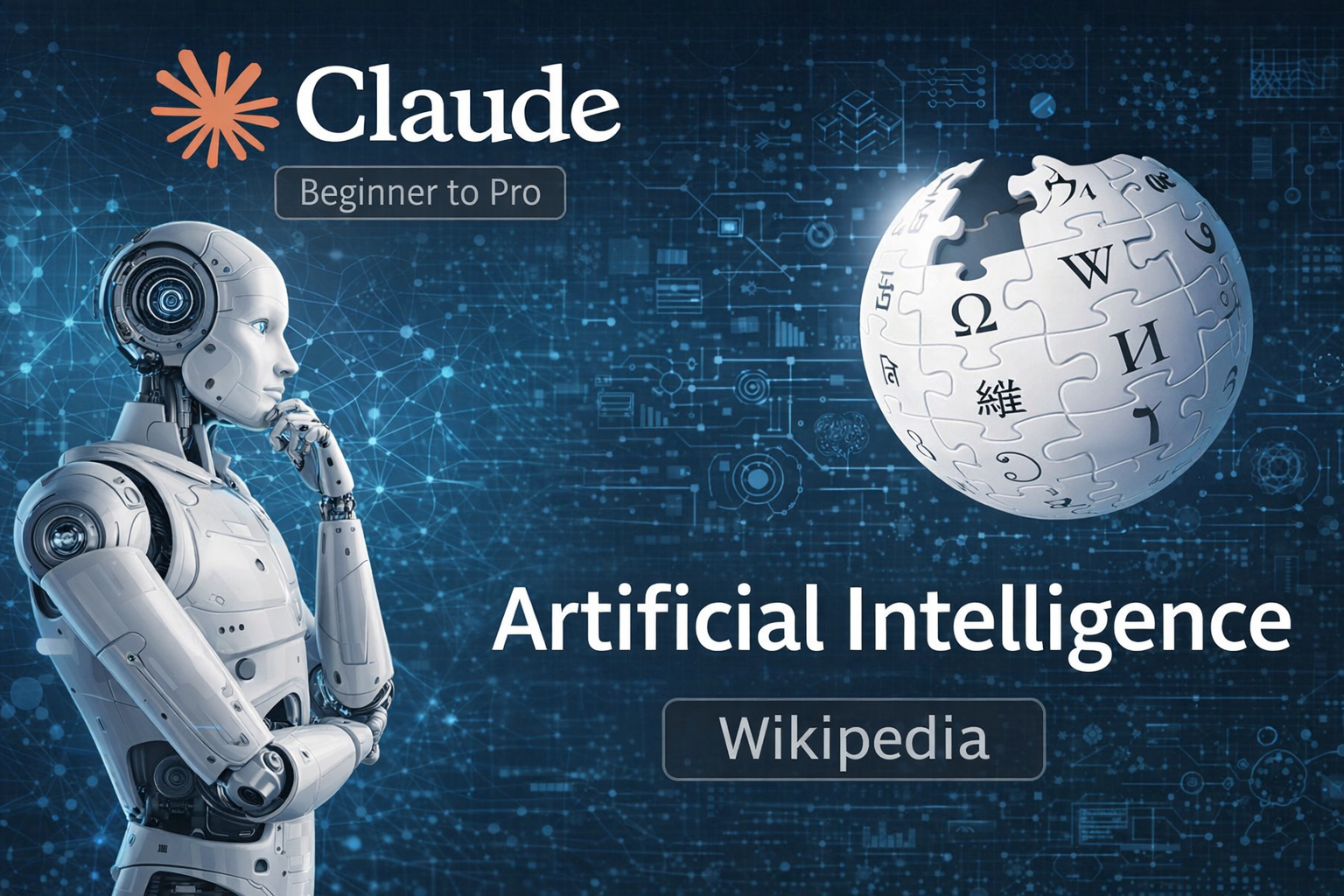
Wikipedia's artificial intelligence entry just got a major update, and it's a wake-up call for anyone still sleeping on AI's exponential growth. The world's most-edited encyclopedia now reflects what we've all been watching unfold: artificial intelligence has moved from theoretical computer science into the operational backbone of virtually every industry. If you haven't read what Wikipedia editors are saying about AI's current state, you're missing critical context about where this technology is actually headed?and why it matters for your business, career, and future.
The timing couldn't be more critical. OpenAI just dropped GPT-5 ? and it changes everything we thought we knew about AI, while simultaneously, African businesses face an unprecedented pressure to adapt or become irrelevant. Wikipedia's comprehensive breakdown of AI?from machine learning fundamentals to real-world applications?provides the foundational knowledge you need to understand why this moment matters.
What Wikipedia's AI Entry Actually Says (And What It Means)
Wikipedia's artificial intelligence section covers the essential terrain: machine learning, neural networks, deep learning, and natural language processing. But here's what matters right now?the encyclopedia documents how AI has evolved from academic curiosity to practical necessity. The tools are no longer experimental. They're production-ready.
The critical insight buried in Wikipedia's technical definitions is this: AI isn't one thing. It's a spectrum of capabilities, each with different implications. The rise of multimodal AI: why seeing, hearing, and reading changes everything represents the next evolutionary step beyond text-based models. These systems can process images, audio, and text simultaneously?exponentially expanding what's possible.
When Wikipedia documents the history of AI?from the Dartmouth Conference in 1956 to today's large language models?it's essentially charting the trajectory of a technology that's now reshaping labor markets, healthcare systems, and business operations globally. The academic theories are now lived reality.
The Immediate Business Impact Wikipedia Doesn't Fully Capture
Wikipedia's AI entry is thorough on technical definitions, but the real urgency lies in application. Why African businesses that ignore AI in 2026 will not survive 2028 isn't hyperbole?it's observable economic pressure. Companies using AI for automation, customer service, content generation, and data analysis are operating at cost structures that non-AI companies simply can't match.
The Wikipedia article documents AI's capabilities. What it doesn't emphasize enough: the speed of adoption. Organizations are deploying 10 AI automation tools that will replace your entire workflow in 2026 right now. Individuals are building entire businesses on AI infrastructure. The window for "learning about AI" is closing rapidly?the window for "actually using AI" is open and narrowing.
The question isn't whether AI will change your industry. Wikipedia's documentation proves it already has. The question is whether you'll adapt before your competitors do.
Consider the labor market impact. The honest truth about AI and jobs that nobody wants to say out loud is that certain roles are already being automated. Wikipedia's technical documentation doesn't address the urgency of reskilling, but the economic reality does. Roles that involved routine content generation, basic data analysis, or customer service categorization are evaporating.
What the AI Comparison Wars Actually Tell Us
Wikipedia treats different AI systems academically?describing their architectures and training methodologies. But practitioners need actionable intelligence. Claude vs ChatGPT vs Gemini: I used all three for 30 days. Here is the honest verdict provides the practical reality that Wikipedia's technical entry can't deliver. These systems have vastly different strengths, and choosing correctly for your use case matters enormously.
The same applies to specialized tools. AI video generation in 2026: the tools that actually work (tested) represents a category that Wikipedia mentions theoretically but doesn't evaluate practically. Video generation has moved from "coming soon" to "production-ready" in weeks, not years. The documentation lag is massive.
Wikipedia also doesn't adequately capture the competitive dynamics. Microsoft Copilot vs Google Workspace AI: the enterprise AI battle nobody saw coming shows how traditional software giants are pivoting entire product strategies around AI. This isn't a footnote in technology history. This is the central narrative of 2026 enterprise computing.
Building With AI: The Reality Beyond Wikipedia's Definitions
Wikipedia's AI entry documents what AI is. It doesn't explain what you can build with it. How to build an AI startup in 2026 without writing a single line of code represents a fundamental shift: technical barriers have collapsed. Non-technical founders are launching AI-powered companies. No-code platforms are enabling rapid experimentation and deployment.
This changes everything about career planning and business strategy. How to make $5,000/month using AI tools ? the honest guide isn't fantasy. Freelancers are already doing this by positioning themselves as AI workflow experts, consultants, and implementers. The opportunity window is genuinely open right now.
Content creators have specific urgency. The 8 AI tools every content creator needs in 2026 (ranked by actual ROI) documents tools that have moved from "interesting experiments" to "essential infrastructure." Content creators using AI for research, drafting, and optimization are producing multiples more work in the same time.
For anyone starting their AI journey, Complete beginner's guide to AI tools in 2026: start here if you're overwhelmed provides the step-by-step approach that Wikipedia's encyclopedic structure can't match. You need focused, actionable guidance, not comprehensive technical documentation.
The Healthcare and African Context That Wikipedia Misses
Wikipedia documents AI applications broadly. It doesn't adequately capture regional implications. How AI is quietly transforming healthcare across Africa ? and what it means for patients reveals how AI isn't just disrupting Western industries?it's reshaping healthcare access in regions where traditional infrastructure is limited. Diagnostic AI, drug discovery acceleration, and population health monitoring are improving outcomes with minimal physical infrastructure.
This has immediate policy and business implications for the African continent that Wikipedia's general-interest article can't address with necessary urgency. AI represents a genuine opportunity to leapfrog traditional infrastructure limitations?but only for organizations that move quickly.
The Knowledge Gaps Becoming Critical
Wikipedia documents AI concepts. It doesn't teach execution. How to use AI to dominate SEO in 2026 ? the complete playbook and The only prompt engineering guide you will ever need in 2026 represent the actual skill gaps. You can understand what prompt engineering is theor
💬 0 Comments
+ Leave a comment