
When you type a question into ChatGPT and watch it generate a thoughtful response word-by-word, you're witnessing the culmination of an engineering feat that combines web-scale data collection, mathematical sophistication, and computational power that seemed impossible just five years ago. But how does it actually work? The journey from raw internet text to a conversational AI isn't magic?it's a series of precise, deliberate steps that transform unstructured data into statistical patterns that can generate human-like language.
Understanding how large language models function is no longer a niche technical concern. Whether you're exploring OpenAI's latest breakthroughs, evaluating which AI tool to use for your workflow, or considering building an AI-powered startup, the mechanics matter. They explain both the capabilities and limitations of the systems reshaping our world.
The Foundation: Harvesting Human Knowledge at Scale
The first and perhaps most critical phase of building a modern language model involves acquiring data. Frontier models in 2024 train on approximately 15 trillion tokens?roughly equivalent to 44 terabytes of text. To put that in perspective, that's the contents of roughly 10 consumer hard drives completely filled with high-quality written text representing the breadth of human knowledge.
This raw material doesn't arrive pre-packaged. It begins with organizations like Common Crawl, which have been systematically indexing the internet since 2007. Their infrastructure has catalogued approximately 2.7 billion web pages, stored as compressed WARC files containing raw HTML, JavaScript, CSS, navigation menus, ads, and everything else that comprises a web page.
But raw internet data is like crude oil?valuable in aggregate, but requiring substantial refinement. The filtering pipeline removes:
- Malicious content: Blocklists eliminate known malware sites, spam networks, and adult content before any deeper processing begins
- HTML cruft: Parsers extract meaningful text while discarding navigation elements, advertisements, and styling information
- Non-target languages: Pages with less than 65% English content are dropped (though multilingual models make different choices)
- Duplicate material: MinHash algorithms identify and remove the millions of copied articles and boilerplate text that pervade the web
- Personal information: Regex patterns and machine learning classifiers detect and redact phone numbers, Social Security numbers, email addresses, and named individuals
This filtering process is neither neutral nor trivial. The quality and diversity of training data has more impact on the final model's capabilities than nearly any other factor. Teams spend substantial effort on this unglamorous work because they understand the principle: garbage in, garbage out?but now at trillion-token scale.
The result is datasets like FineWeb, which contain approximately 44 terabytes of high-quality, diverse documents spanning medicine, history, code repositories, recipes, science papers, and countless other domains.
Converting Language to Mathematics: Tokenization
Neural networks don't understand language. They understand numbers. The bridge between these two worlds is tokenization?the process of breaking text into manageable chunks called tokens and assigning each a numerical identifier.
The naive approach would be to treat each word as a single token. This fails catastrophically for several reasons. English contains virtually infinite word variants: "run," "running," "runner," "ran," "runs." Using a dictionary would require millions of entries. New words, slang, typos, and words from other languages would constantly appear during inference, breaking the model.
Modern language models instead use Byte Pair Encoding (BPE), an elegant algorithm that constructs a vocabulary optimized for the specific dataset. GPT-4 uses approximately 100,277 tokens in its vocabulary. BPE works by starting with individual bytes (256 symbols) and iteratively merging the most frequently occurring adjacent pairs in the training corpus. This creates a vocabulary where common sequences become single tokens, while rare or novel words decompose into constituent sub-word pieces.
The practical advantage is substantial. "running" might tokenize as "run" + "ning," allowing the model to understand morphologically related words as variations on a shared root. The same mechanism handles typos, multiple languages, and entirely new words elegantly.
The tokenization choice affects downstream model behavior in ways that aren't always obvious. Different token boundaries can emphasize different linguistic relationships. This is why prompt engineering techniques sometimes work?they're exploiting how specific phrasings tokenize.
The Core Mechanism: Training the Transformer
Once data is collected and tokenized, the actual neural network training begins. Modern language models are built on the Transformer architecture, introduced in 2017. A Transformer is initialized with billions of randomly assigned parameters?essentially billions of "knobs" that will be adjusted during training.
The training process is conceptually straightforward but computationally immense:
- Sample a sequence of tokens from the training data
- Feed this sequence into the Transformer network
- The network predicts what token should come next
- Compare the prediction to the actual next token in the training data
- Calculate an error metric called "loss"
- Adjust all billions of parameters slightly to reduce this error
- Repeat billions of times
Across millions of training steps, the loss steadily decreases. The model learns statistical patterns about language?which word sequences are likely, which are improbable, which convey meaning, and which are contradictory. It's learning compressed representations of grammar, facts, reasoning patterns, and cultural knowledge, all encoded in the weights of a neural network.
The scale of this undertaking has increased dramatically. GPT-2 in 2019 contained 1.6 billion parameters and trained on 100 billion tokens for approximately $40,000. Today, a model of equivalent quality trains for roughly $100. Current frontier models like Meta's Llama 4 contain 405 billion parameters and train on 15 trillion tokens, representing an increase in scale of thousands of times with a simultaneous decrease in per-unit cost.
The Intelligence Emerges: Scaling Laws
One of the most counterintuitive discoveries in recent AI research is the predictability of scaling laws. When you plot the relationship between model size, training data volume, and downstream performance, a clear pattern emerges: performance improves logarithmically with scale.
This means:
- Doubling model parameters yields a predictable improvement in performance
- Doubling training data produces a measurable capability increase
- These relationships hold across multiple orders of magnitude
- Emergent behaviors (like the ability to do arithmetic or translate languages) appear unexpectedly at certain scales
This scaling relationship is why organizations have been willing to invest billions in ever-larger models. It's not irrational exuberance?it's empirically justified. The model that changes everything we thought we knew about AI won't do so through a novel architecture. It will do so through consistent application of scaling laws at even larger scales.
From Training to Conversation: Fine-Tuning and Alignment
A pre-trained language model is not yet a helpful assistant. It's a sophisticated text predictor trained to continue any input sequence in a statistically likely way. A model trained on internet text will complete toxic prompts toxically. It will hallucinate facts. It will refuse helpful requests if they follow refusal patterns from its training data.
This is where the second phase of training becomes essential: fine-tuning and alignment. After pre-training, models undergo further training on curated datasets where humans have demonstrated desired behavior. Reinforcement Learning from Human Feedback (RLHF) explicitly optimizes for outputs that human raters prefer.
This process is where the assistant you interact with takes shape?where a text predictor becomes something that acknowledges limitations, refuses harmful requests, and attempts to be genuinely helpful. Different organizations make different choices here, which is why comparing different AI tools reveals substantial differences in personality and approach.
Inference: The Moment of Generation
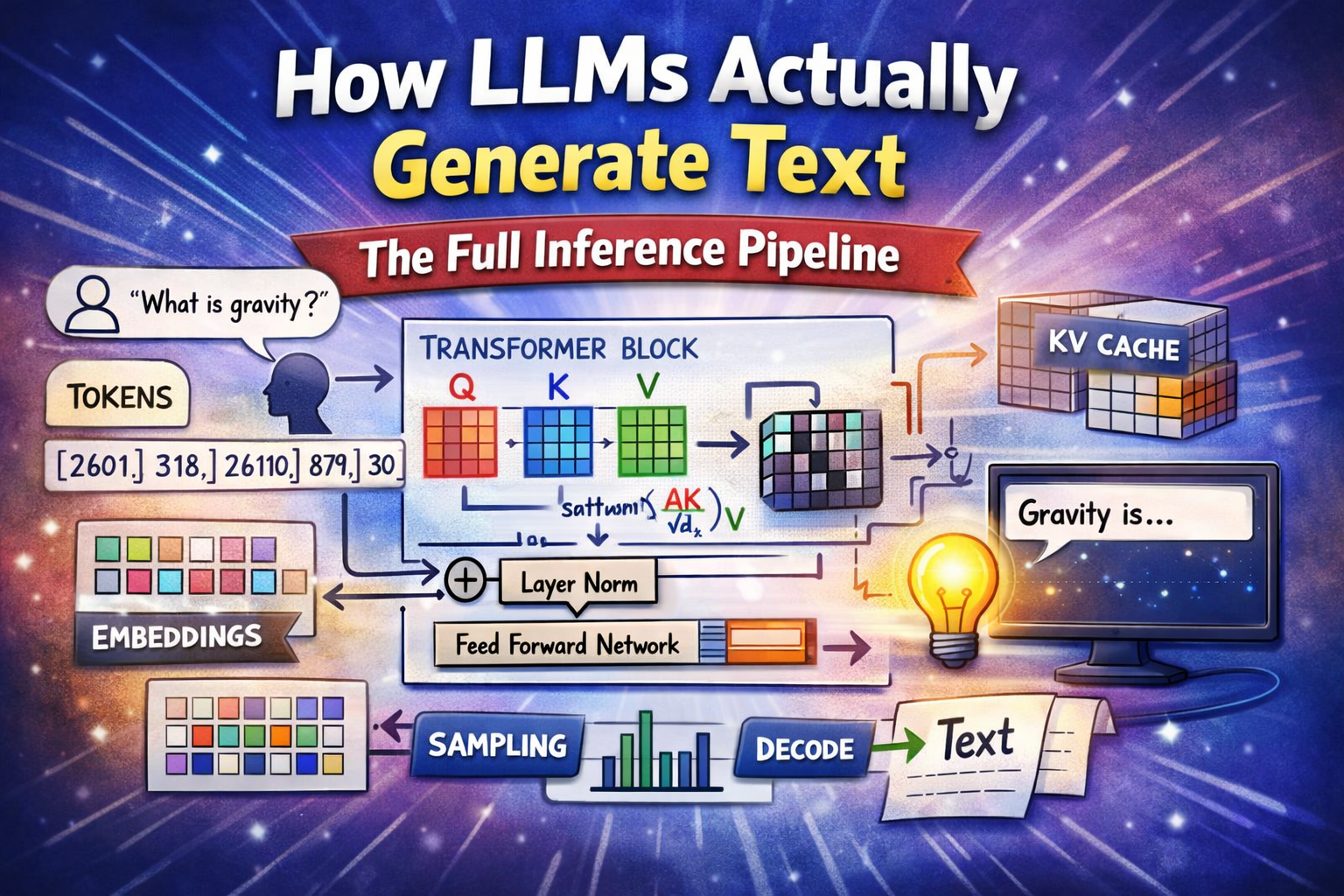
When you submit a prompt to a language model, inference begins. The model doesn't "think" about your question and then formulate an answer. Instead, it generates text token-by-token, each new token predicted based on all previous tokens.
The process works like this:
- Your prompt is tokenized using the same BPE vocabulary from training
- These tokens flow through the Transformer's attention layers, where each token can "look back" at previous tokens to understand context
- The final layer outputs probabilities for which token should come next
- A token is sampled from this probability distribution (with some temperature adjustment controlling randomness)
- This new token becomes part of the context for the next prediction
- The process repeats until a stopping condition is met
This is why language models sometimes produce hallucinated information with absolute confidence. They're not accessing an external knowledge base. They're predicting the next statistically likely token based on patterns in training data. If the training data contained plausible-sounding false information, the model will reproduce it.
Why This Matters for Your Work
Understanding this architecture explains both the impressive capabilities and genuine limitations of current AI systems. If you're building an AI startup, implementing AI automation, or adopting AI tools for content creation, this knowledge matters.
Language models excel at pattern recognition and statistical inference. They struggle with tasks requiring external knowledge lookup, precise calculation, or logical deduction. They're not "thinking"?they're predicting. This realization should inform how you deploy them.
The best AI implementations combine language models' natural language capabilities with agentic systems that can take actions or access external information. A chatbot alone has limited utility. A chatbot connected to your business's database, capable of triggering actions, and constrained by guardrails?that's transformative.
The Road Ahead
The architecture described here?Transformers trained at scale on internet text with RLHF alignment?has defined the frontier for three years. New approaches are emerging. Multimodal models that combine language with vision and audio are becoming standard. Mixture-of-Experts architectures allow conditional computation. Inference optimization techniques make these massive models deployable on consumer hardware.
But the fundamental mechanism remains: collect data, tokenize, train at scale, align to human preferences, generate tokens one-at-a-time during inference. It's not glamorous. It's not conceptually novel in isolation. Yet the combination at unprecedented scale produces capabilities that rival human performance on many tasks.
The next evolution won't require abandoning this understanding. It will require building on it?combining language model capabilities with reasoning, planning, and tool use to create systems that genuinely augment human capability rather than simply predicting the next word.
For anyone working in the space?whether you're exploring how to generate income with AI tools or applying AI to competitive advantage in your industry?this is the moment to understand the foundations. The technology will evolve. The principles underlying it will persist.
```

💬 0 Comments
+ Leave a comment