
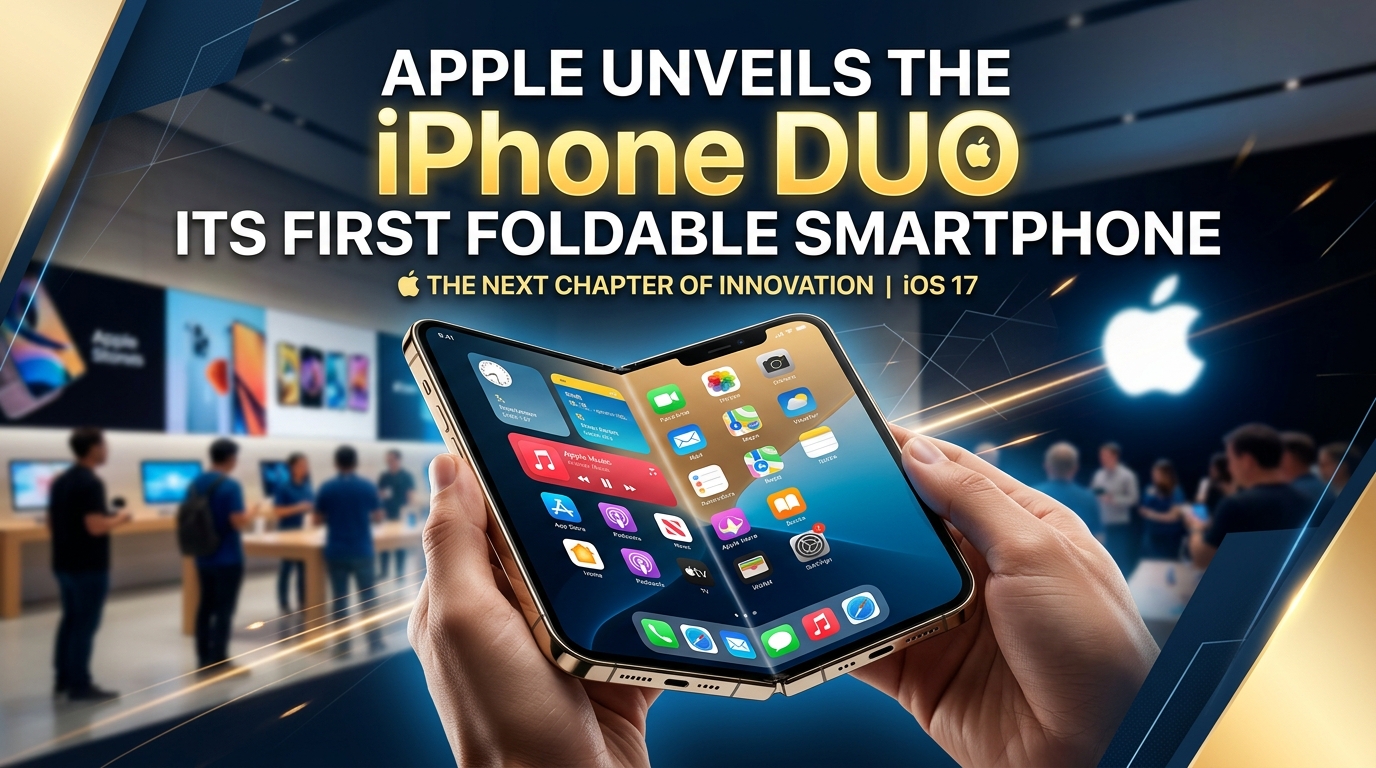
Apple has officially entered the foldable smartphone market with the announcement of the iPhone Duo, marking a significant pivot in the company's hardware strategy. After years of watching competitors like Samsung dominate the foldable space, Apple's first foldable device arrives with characteristic refinement, cutting-edge AI integration, and a price tag that positions it as a premium offering in a category that's rapidly maturing.
The announcement represents more than just a new product category for the Cupertino giant. It signals Apple's commitment to pushing innovation boundaries while leveraging artificial intelligence in ways that could reshape how users interact with foldable technology. In a landscape where multimodal AI is fundamentally changing how devices process information, the iPhone Duo arrives with sophisticated AI capabilities baked into its hardware and software architecture.
The Hardware: Engineering Meets Ambition
The iPhone Duo features a revolutionary 8.3-inch foldable OLED display that unfolds from a compact 5.8-inch form factor. Apple's engineers spent years perfecting the hinge mechanism, resulting in a nearly imperceptible crease that's barely visible when the screen is powered on. The device weighs just 240 grams and measures 5.5mm thick when folded, making it one of the thinnest foldables on the market.
The display technology is where Apple's obsessive attention to detail becomes apparent. Rather than relying on conventional foldable panels, Apple developed its own proprietary OLED technology specifically engineered for the bending environment. The result is a display that maintains brightness and color accuracy whether folded or unfolded, with HDR support and a 120Hz refresh rate that delivers buttery-smooth animations across both screens.
Processing power comes from Apple's A18 Pro chip, the same processor found in the flagship iPhone 16 Pro lineup. However, the iPhone Duo variant features enhanced neural processing capabilities designed specifically for on-device AI tasks. This is crucial because, as discussions around how to leverage AI effectively in 2026 have shown, on-device processing is becoming essential for both privacy and performance.
AI Integration: The Real Innovation Story
While the hardware is impressive, the iPhone Duo's true differentiation lies in its AI capabilities. Apple has integrated what it calls "Adaptive Intelligence"—a system that uses device-based machine learning to understand context, predict user needs, and optimize performance in real-time.
The dual-screen format enables entirely new AI-powered workflows. The device can simultaneously display information across both screens, with the AI engine intelligently distributing tasks based on what's most computationally efficient. When you're writing an email on the main display, the device might show relevant information on the secondary screen—without requiring additional gestures or manual switching. This represents the kind of agentic AI behavior that will define the next decade, where devices actively assist rather than simply respond to commands.
Apple's implementation of on-device language models also deserves attention. Rather than sending data to cloud servers, the iPhone Duo processes natural language requests directly on the device, ensuring privacy while maintaining the speed users expect. For those building AI-powered solutions, this approach offers lessons in architecture—much like how entrepreneurs are building AI startups without writing code, Apple is demonstrating how thoughtful AI design matters as much as raw capability.
Camera System and Computational Photography
The iPhone Duo features a triple-camera system with dual 48MP main sensors (one on each side of the device), a 12MP ultra-wide lens, and a 12MP telephoto. However, the camera innovation extends beyond megapixel counts. Apple's computational photography engine uses neural processing to deliver real-time enhancements.
The device can capture images differently depending on which display is active, enabling creative workflows previously impossible on smartphones. When using both screens, the AI analyzes composition in real-time and offers suggestions—a feature that could revolutionize mobile photography, particularly for content creators who rely on AI tools to enhance their creative output.
Pricing and Market Positioning
Apple priced the iPhone Duo starting at $1,799 for the base 256GB model, with storage options extending to 1TB. This positions it above the iPhone 16 Pro Max but below ultra-premium competitor offerings. The pricing reflects Apple's confidence that foldable technology has matured beyond novelty status.
For enterprise users, Apple introduced volume licensing options, recognizing that foldables are increasingly valuable for business workflows. This aligns with broader trends where businesses ignoring technological advancement are facing existential challenges, and foldable devices represent the next step in mobile productivity.
What This Means for the Industry
Apple's entry into foldables legitimizes the category in ways Samsung's innovations alone never could. For a company that famously waits to enter markets until it can do so differently, the iPhone Duo represents confidence that foldable technology has crossed a maturity threshold.
The device will ship with iOS 19, which includes new multitasking features specifically designed for foldable displays. App developers can now create experiences that leverage the expanded screen real estate, much like how AI automation tools are fundamentally changing how workflows function.
The iPhone Duo also represents Apple's answer to the broader AI revolution reshaping consumer technology. Where competitors have sometimes rushed AI features to market, Apple's approach reflects patience and refinement. The device arrives not as an experimental platform but as a fully mature product where AI capabilities work as seamlessly as operating systems from various providers.
Apple's iPhone Duo is far more than a foldable smartphone—it's a statement about the future of mobile technology. By combining thoughtful hardware design with sophisticated on-device AI, Apple has created a device that hints at how smartphones will evolve over the next decade. Whether you're an early adopter eager to explore foldable productivity or a business leader understanding that AI is transforming industries from healthcare to manufacturing, the iPhone Duo represents a meaningful inflection point in consumer technology.
The foldable smartphone market is no longer about novelty—it's about functionality, and Apple's entry into this space with a mature, AI-integrated product suggests the category has finally delivered on its long-promised potential. For those interested in how technology shapes business and society, the iPhone Duo deserves serious attention.
```


💬 0 Comments
+ Leave a comment