
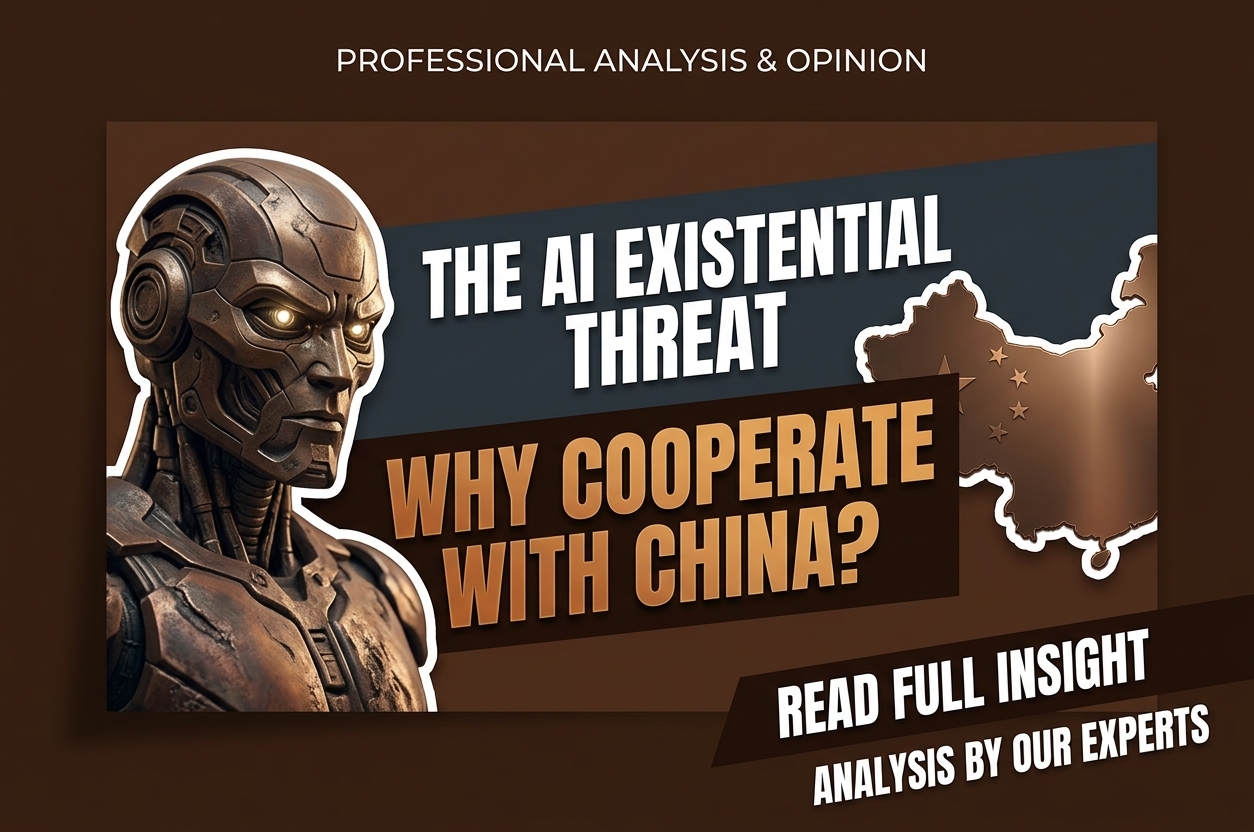
There's a peculiar contradiction at the heart of the artificial intelligence debate that nobody seems willing to articulate clearly: if we genuinely believe AI poses an existential threat to humanity, why are we allowing—or worse, enabling—China to become a global leader in the technology?
This isn't a question about geopolitics or economic competition. It's a fundamental question about risk management. And the answer reveals something uncomfortable about how we actually prioritize existential threats versus national interests.
The Existential Risk Argument Versus the Strategic Reality
Over the past three years, a compelling narrative has emerged from leading AI researchers and technologists. OpenAI Just Dropped GPT-5 ? And It Changes Everything We Thought We Knew About AI marked another inflection point in this conversation. The argument goes something like this: advanced AI systems could eventually become superintelligent, uncontrollable, and hostile to human interests. This isn't fringe thinking anymore. It's articulated by people like Sam Altman, Demis Hassabis, and Dario Amodei.
If that risk is real—if we're genuinely worried about AI systems that could kill us all—then allowing a geopolitical competitor to lead in AI development represents an astonishing gamble with human survival itself.
Yet that's precisely what's happening. China invests heavily in AI. It publishes cutting-edge research. It builds large language models. And Western governments, while vocally concerned about existential risk, continue to allow this development to proceed with remarkably few constraints.
The cognitive dissonance is staggering.
Why We're Actually Paralyzed
The uncomfortable truth is that we don't actually believe the existential risk argument when it matters most. If we did, we wouldn't have time for nuance or commercial optimization. We'd act like we're in a wartime footing.
Instead, what we're seeing is selective concern. When it's convenient—when discussing AI regulation or safety investments—we invoke existential risk. When it's inconvenient—when discussing trade policy, immigration of AI talent, or technological competition with China—we quietly set that concern aside.
There are three reasons for this paralysis:
- Economic incentives: Companies like OpenAI, Google, and Meta benefit from accessing Chinese talent, markets, and computational resources. A genuine AI containment strategy would require sacrificing billions in potential value.
- Regulatory uncertainty: Governments don't know how to regulate AI without crippling domestic innovation. So they regulate poorly or not at all, which means they certainly aren't going to restrict competitors.
- Credibility gap: Existential risk messaging has been oversold. The Honest Truth About AI and Jobs That Nobody Wants to Say Out Loud is that we're better at predicting near-term disruption than long-term extinction. This credibility gap makes it easier to dismiss existential warnings as hype.
But here's what matters: credibility gaps don't change the underlying physics of the problem. They just make it harder to coordinate a rational response.
The False Choice Between Innovation and Safety
The tech industry presents this as a binary: either we innovate freely and accept the risks, or we stifle progress with regulation. This framing is deliberately misleading.
Strategic coordination around AI development is entirely possible. The Manhattan Project wasn't about stifling physics. It was about ensuring that one side—not all sides equally—had access to a transformative technology. Meta's Llama 4 Is the Most Important Open-Source AI Release in History ? Here's Why represents the opposite approach: distributing powerful AI capabilities globally on an open-source basis.
Both approaches are choices. Neither is inevitable. But if we genuinely believe existential risk matters, then the open-source approach—which accelerates capability development globally and reduces the possibility of containing or controlling dangerous systems—seems irrational.
The question isn't whether we should innovate. It's how we should innovate, where we should innovate, and who should have access to the most powerful systems.
Yet these conversations barely happen in mainstream policy circles.
What Strategic AI Competition Actually Looks Like
If Western policymakers took existential AI risk seriously, the response would look like strategic technology competition, not free-market competition:
- Restricting the export of advanced AI models and training infrastructure to strategic competitors
- Controlling the international flow of top AI talent through visa and emigration policy
- Investing heavily in domestic AI capability to ensure self-sufficiency
- Coordinating with allied nations on shared AI development standards and safety protocols
- Treating foundational AI research like nuclear technology: with serious government oversight and strategic coordination
None of this is happening at scale. Instead, we see performative regulation—safety boards that lack enforcement power, voluntary commitments that companies ignore, and regulatory frameworks that don't actually restrict capability development.
This isn't an accident. It's the result of powerful economic incentives aligned against strategic restraint.
The Real Answer
If AI truly poses an existential risk, giving China—or any geopolitical competitor—"any ground" is unconscionable. But we are giving ground, constantly, and the fact that we're comfortable doing so tells us something important:
We don't actually believe the existential risk narrative enough to change our behavior when it matters.
This doesn't mean the risk isn't real. It means we're gambling with human survival because the immediate economic and geopolitical incentives overwhelm long-term risk management. We're prioritizing the next quarter's earnings and the next election cycle over the next century's existence.
This is perfectly rational for individual companies and politicians, and perfectly irrational for humanity as a whole. It's a classic coordination problem, and we're watching it play out in real time.
The solution isn't more safety talk or voluntary commitments. It's treating AI development like what it actually is: a technology that could reshape civilization, and therefore something too important to leave entirely to market forces and individual companies. Whether that means international treaties, government control, or some hybrid approach remains unclear. But the current approach—talking about existential risk while acting as though it doesn't matter—isn't sustainable.
For those interested in the broader AI landscape, Claude vs ChatGPT vs Gemini: I Used All Three for 30 Days. Here Is the Honest Verdict offers perspective on how capability competition is actually playing out. Meanwhile, Why African Businesses That Ignore AI in 2026 Will Not Survive 2028 shows why these questions matter beyond Western policy circles. And for those building with AI today, Complete Beginner's Guide to AI Tools in 2026: Start Here If You're Overwhelmed provides practical grounding in the technology everyone's debating.

💬 0 Comments
+ Leave a comment