
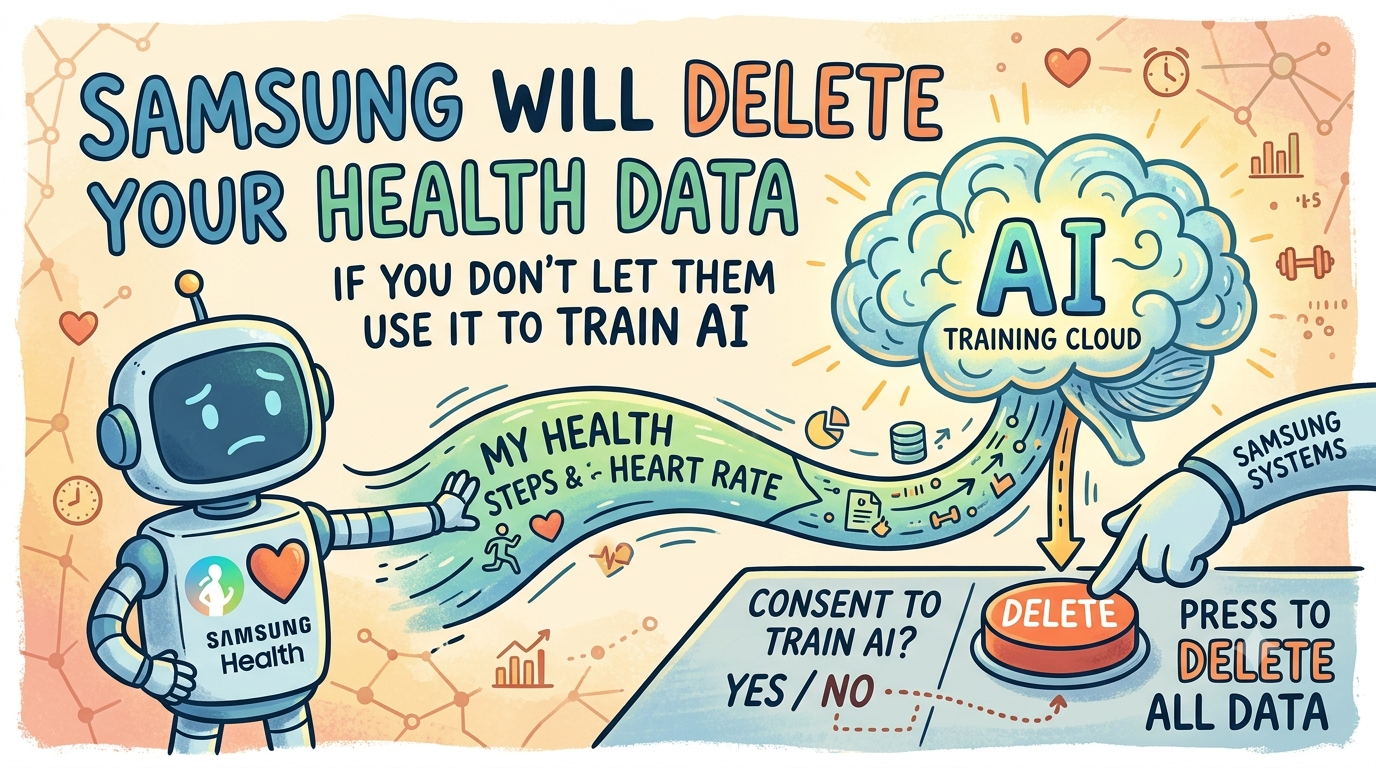
Samsung just drew a line in the sand—and it's asking users to choose a side. The company is now requiring consent to use personal health data for artificial intelligence training, with an unsettling ultimatum attached: agree to let Samsung leverage your intimate medical information, or watch years of carefully tracked health records disappear forever.
This isn't a gentle nudge toward better data practices. It's a hard reset bundled with an impossible choice that raises critical questions about consent, data ownership, and how far technology companies will push users in their race to fuel AI advancement.
The Samsung Health Ultimatum: Consent or Deletion
Deep within the Samsung Health application settings, users are discovering a new toggle labeled "Consent to the Use of Health Data for AI training and modelling." What appears to be a straightforward privacy option quickly reveals itself as something far more coercive. Samsung isn't simply asking for permission—it's issuing an order masquerading as a choice.
When users attempt to disable this feature, Samsung displays a stark warning message that essentially reads: back off, and your data will vanish. The company states that refusing to consent means users "will not be able to sync health data with your Samsung account and your health data will be deleted unless retained pursuant to applicable law." The message leaves little room for negotiation or middle ground.
This approach mirrors broader trends in how technology companies are handling the AI boom. While competitors like OpenAI Just Dropped GPT-5 ? And It Changes Everything We Thought We Knew About AI, companies across the industry are scrambling to access user data for model training. Samsung's approach, however, stands out for its aggressive implementation and explicit threat of data deletion.
What Health Data Is Samsung Targeting?
Samsung isn't being coy about its ambitions. The company has publicly outlined four specific categories of health information it intends to harvest for AI training:
- Sleep patterns and sleep quality metrics
- Medication records and pharmaceutical history
- Medical records and healthcare documentation
- Menstrual and reproductive cycle tracking data
These aren't merely fitness statistics or step counts. These are deeply personal health indicators that many users consider sensitive medical information. Sleep data can reveal mental health conditions. Medication records expose diagnoses. Cycle tracking is particularly intimate. The breadth of what Samsung is requesting goes far beyond typical fitness app metrics.
Adding another layer of concern: Samsung has acknowledged that humans—including Samsung employees and third-party contractors—will be able to access and review portions of this data. Your medical history isn't staying locked in an algorithm. Real people will potentially see it as part of the training and refinement process.
The AI Features Samsung Wants to Build
To understand why Samsung is being so aggressive about data collection, it's worth examining what the company is actually building. Samsung Health recently underwent a massive generative AI overhaul timed to coincide with the Galaxy Watch 9 and One UI 9 Watch launches. The company has introduced several new features that directly depend on the health data it's now demanding access to.
The flagship feature is called "Vitals," a tool that analyzes your overnight biometric signals and compares them against your personal baseline. It monitors five key signals: heart rate, heart rate variability, respiratory rate, skin temperature, and blood oxygen levels. When the system detects anomalies, it can alert you to potential illness or fatigue before you notice symptoms yourself.
Samsung has also launched a "Heart Health Score" feature that consolidates body composition, daily activity, sleep metrics, and stress levels into a single dashboard card. There's a "Cardio Load" metric designed to prevent overtraining, and a "Fitness Index" that grades your overall fitness by comparing metrics like VO2 max and step count against peer data.
These features sound genuinely useful. They could help users identify health issues earlier and optimize their training. The problem is that Samsung has decided the path to building better versions of these tools requires taking hostage the very health data users have already entered into the system. For context on how the AI industry approaches data, consider reading about The Rise of Multimodal AI: Why Seeing, Hearing, and Reading Changes Everything—this explains how companies justify aggregating diverse data sources.
The Broader Implications for Data Ownership
Samsung's approach illuminates a troubling pattern emerging across the technology industry. Companies are increasingly treating user data as a commodity that belongs to them, not something held in trust for users. The reframing is subtle but significant: your data isn't yours to control—it's a resource the company can leverage, and you're simply a temporary custodian.
This represents a fundamental shift from earlier app privacy models. Previously, companies collected data to improve their services for you. Now, companies are collecting data to train AI models that may be sold, licensed, or monetized in ways entirely disconnected from your user experience. You're not just a customer anymore—you're an unpaid data labeler.
The coercive nature of Samsung's consent mechanism makes this worse. Users aren't being offered a genuine choice. They're being offered a false binary: surrender your data or lose access to the information you've already stored. That's not informed consent—it's digital hostage-taking dressed up in privacy language.
For perspective on how AI development is reshaping entire industries and employment models, The Honest Truth About AI and Jobs That Nobody Wants to Say Out Loud provides context on the broader transformation underway.
Regulatory Questions and Legal Vulnerabilities
Samsung's strategy could face legal challenges, particularly under emerging regulations like the EU's Digital Services Act and similar privacy frameworks being implemented globally. Several jurisdictions have begun questioning whether deletion of user data can legitimately serve as a "consequence" of refusing consent.
The legal theory Samsung appears to be using is that cloud backup and syncing is a "service" they're providing, and users who refuse data sharing agreements simply lose access to that service. There's some precedent for this argument, but it's increasingly contentious in regulatory circles. Privacy advocates argue that penalizing users for refusing to participate in AI training programs violates the spirit—if not the letter—of GDPR and similar regulations.
Additionally, the involvement of third-party contractors in reviewing health data creates complications. Samsung may be creating contractual obligations with these contractors that supersede user consent agreements. Users have no way of knowing who these contractors are, where they're located, or what obligations they have to protect the data they're accessing.
What Users Can Actually Do
If you're a Samsung Health user facing this dilemma, your options are limited but not nonexistent. You can refuse consent and accept deletion, effectively starting fresh with your health data. Some users are exploring third-party health apps that don't demand AI training access, though this means losing Samsung ecosystem integration.
Alternatively, you can provide consent while taking steps to minimize what data you enter going forward. Some users are consolidating sensitive data (like medication records) into encrypted password managers rather than Samsung Health, using the Samsung app primarily for fitness metrics that feel less sensitive.
The reality is that individual workarounds feel inadequate for addressing a systemic problem. This is why collective pressure matters more—users, privacy advocates, and regulators need to establish clearer norms about what constitutes acceptable consent mechanisms. Deleting data as punishment for refusing to participate in training programs should not become standard practice across the industry.
To understand how different AI platforms approach user data differently, consider comparing Claude vs ChatGPT vs Gemini: I Used All Three for 30 Days. Here Is the Honest Verdict—companies have varying philosophies about data usage.
The Broader Industry Trend
Samsung isn't operating in isolation. This represents a preview of how hardware and services companies plan to monetize AI development. Smartphone makers, smartwatch manufacturers, and ecosystem providers all possess troves of user data and have strong incentives to convert that data into AI competitive advantages.
We're entering an era where device manufacturers view user data as a crucial input to their AI strategy. The question isn't whether companies will ask for access to this data—the question is how aggressive they'll be in their asking, and what penalties they'll attach to refusal.
Some companies will follow Samsung's coercive path. Others will adopt softer approaches, offering genuine opt-in mechanisms and accepting that some users will decline. The companies that build trust during this transition will likely emerge stronger, having developed user bases that genuinely believe their data is being used responsibly.
For companies looking to build sustainable AI businesses, consider reading How to Build an AI Startup in 2026 Without Writing a Single Line of Code—ethical data practices will likely become competitive advantages.
Why This Moment Matters
Samsung's health data ultimatum represents a pivotal moment in determining what kind of relationship we'll have with our devices going forward. Will technology companies view us as partners whose data should be protected, or as resources to be extracted?
The answer to that question isn't predetermined. It depends on whether users, regulators, and ethically-minded technologists push back against coercive consent mechanisms. It depends on whether we establish precedent that data deletion cannot serve as punishment for declining to participate in AI training.
Most immediately, it depends on individual decisions made by millions of Samsung Health users in the coming weeks. Each person who refuses consent sends a signal. Each person who documents their objection creates a record of resistance. Collective action—whether through formal complaints to regulators or through switching to alternative platforms—remains the most powerful lever available to ordinary users.
The concerning part of Samsung's approach isn't that the company wants to improve its health AI features. The concerning part is that it's using coercion to get there. That distinction matters enormously for the technology landscape we're building.
Conclusion
Samsung's ultimatum exposes the reality of AI development in 2025: companies view user data as essential fuel for model training, and they're willing to be aggressive about accessing it. The health data deletion threat is a negotiating tactic dressed up as a technical limitation. It signals that Samsung views user consent as an obstacle to overcome rather than a boundary to respect.
As the AI industry continues its rapid evolution, incidents like this will become more common, not less. The technology companies that build lasting user trust will be those that separate "what we can do" from "what we should do." For deeper context on how AI is reshaping business models and labor, explore How AI Is Quietly Transforming Healthcare Across Africa ? And What It Means for Patients and What Is Agentic AI? The Shift That Will Define the Next Decade of Technology to understand the broader transformation underway.
Users deserve better than this. The technology industry's response to that simple truth will define whether AI development becomes something we willingly participate in, or something we reluctantly endure.
```


💬 0 Comments
+ Leave a comment